The New World screwworm response has entered a new phase after the U.S. Department of Agriculture confirmed the first detection of the parasite in Arizona on October 28, 2026. The case was found in a dog in Cochise County, near the Mexican border, prompting federal and state officials to establish a 20-kilometer infested zone, restrict animal movement, increase surveillance, and release sterile flies.
The Arizona detection adds a third U.S. state to the list of jurisdictions where New World screwworm has been detected during the current resurgence, following cases in Texas and New Mexico. Reuters reported that USDA had recorded 71 U.S. cases since June, with 18 still active as of October 28.
For American agriculture, the development reaches beyond animal health. New World screwworm can affect livestock, wildlife, pets, and, less commonly, people, while the broader response is unfolding alongside the gradual reopening of U.S. cattle-import ports along the Mexican border. USDA’s current schedule calls for Nogales, Arizona, to reopen to cattle imports on November 30 if animal-health conditions and operational requirements continue to support the plan.
Arizona Detection Expands the U.S. Response
USDA’s Animal and Plant Health Inspection Service confirmed the Arizona case on October 28 after samples from the affected dog were tested at the National Veterinary Services Laboratories in Ames, Iowa. The agency said it is working with the Arizona Department of Agriculture on the response.
The infected dog was found in Cochise County, an area immediately relevant to the nation’s southern livestock trade because of its proximity to Mexico. USDA characterized New World screwworm as a serious pest whose larvae feed on living tissue and can create severe wounds and significant economic consequences when infestations are not detected and treated quickly.
The federal response follows the procedures established in USDA’s New World Screwworm Response Playbook. Officials are establishing a 20-kilometer infested zone, implementing animal-movement controls, increasing surveillance and trapping, releasing sterile flies, and conducting targeted outreach to producers, veterinarians, and communities in the affected area.
The USDA’s public screwworm dashboard is updated daily at 6 p.m. Eastern Time, giving officials, producers, veterinarians, and the public a centralized way to follow confirmed detections and response developments.
The Arizona detection also demonstrates why agricultural biosecurity increasingly depends on rapid identification rather than waiting for widespread livestock infections. A single confirmed animal can trigger movement restrictions, additional surveillance, and other containment measures designed to prevent the parasite from establishing itself in a larger geographic area.
Why New World Screwworm Is a Serious Agricultural Threat
New World screwworm is caused by the larvae of Cochliomyia hominivorax. Unlike many pests that feed primarily on dead organic material, screwworm larvae feed on living tissue.
An infestation can begin when an adult female fly lays eggs in a wound or other vulnerable area. The larvae then develop within the living tissue, creating additional damage as they feed. If the infestation is not identified and treated, the resulting wound can become severe.
The agricultural concern is particularly significant for cattle and other livestock because wounds may occur through routine activities such as branding, castration, calving, or other injuries. Wildlife and pets can also become hosts.
USDA has therefore emphasized daily inspection of animals in affected areas. The agency recommends watching for draining or enlarging wounds, maggots or egg masses, unusual discomfort or irritability, and lesions around body openings. Suspected cases should be reported immediately to a veterinarian, state animal-health official, or USDA.
The current U.S. response is designed around early detection because the economic consequences of an established screwworm population could extend well beyond individual animals. Livestock movement, border trade, veterinary costs, herd management, and regional agricultural activity could all be affected if the pest becomes established.
Sterile Flies Become a Major Tool in Containment
One of the most unusual elements of the U.S. response is the use of sterile insects to suppress the screwworm population.
The technique is based on releasing large numbers of sterile male flies into areas where wild screwworm populations could reproduce. When sterile males mate with wild females, the resulting eggs do not produce viable offspring. Repeated releases can therefore reduce the reproductive capacity of the wild population.
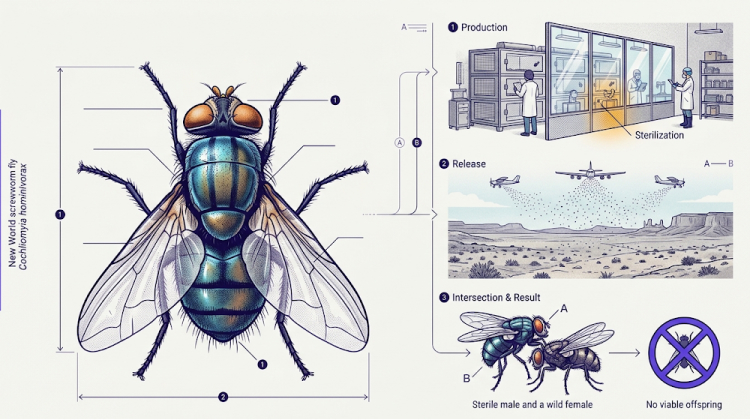
USDA is expanding the infrastructure needed to make that approach possible at a much larger scale.
The department reports that the sterile-fly facility at Moore Air Base in Edinburg, Texas, is operational for dispersal and can release up to 100 million sterile flies per week. USDA is also working with the U.S. Army Corps of Engineers on a domestic production facility in southern Texas that is planned to reach 100 million flies per week initially, with expansion to as many as 300 million per week by late 2028.
The international network is equally important. USDA and Panama jointly operate the COPEG sterile-fly facility in Pacora, which produces approximately 100 million sterile flies per week. USDA also invested in expanding production capacity in Mexico. The Metapa facility in Mexico is expected to reach another 100 million sterile New World screwworm flies per week as it ramps up production.
These facilities provide a biological-control system that can be deployed across areas where surveillance indicates elevated risk.
The approach is especially relevant because screwworm eradication has historical precedent in North America. The pest was previously eliminated from the United States, making the current resurgence a major agricultural biosecurity concern.
Texas and New Mexico Remain Important to the Response
Arizona is now the third U.S. state with confirmed detections in the current outbreak, but the response has been developing across the Southwest for months.
Texas has been a major focus of USDA surveillance and containment efforts. The department has modified infested zones in response to changing case information, while state and federal authorities have continued monitoring animals and potential wild-fly activity.
New Mexico has also played an important role. USDA previously approved the release of the state’s only New World screwworm infested zone on August 30 after state officials determined that the zone met the requirements for release. That decision demonstrated that containment measures can eventually allow restrictions to be removed when surveillance and mitigation conditions support it.
The experience in New Mexico provides an important counterpoint to the Arizona detection. A confirmed case does not automatically mean that a permanent infestation will develop. Instead, authorities use surveillance, treatment, movement controls, sterile-insect releases, and other measures to determine whether the parasite can be contained.
That makes the quality and speed of agricultural surveillance particularly important.
Mexico Cattle Trade Adds an Economic Dimension
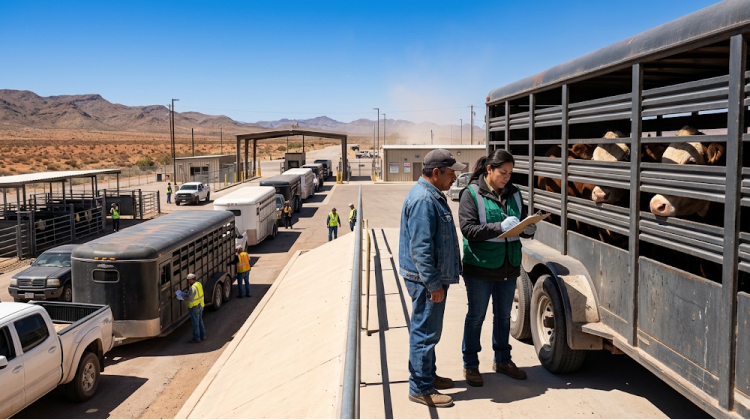
The Arizona detection comes while USDA is gradually reopening U.S. southern border ports for livestock imports from Mexico.
USDA reopened the Douglas, Arizona, port to cattle imports on August 24 and Santa Teresa, New Mexico, on September 24. The Columbus, New Mexico, port reopened on October 26. The current USDA schedule lists Nogales, Arizona, for November 30, provided conditions remain suitable and required safeguards are in place.
These openings are being conducted in phases rather than through a full restoration of livestock trade at every southern border port.
USDA says the import process incorporates enhanced animal-health safeguards, inspections, and protocols intended to prevent infected animals from entering the United States. All other southern border livestock ports remain closed under the current schedule.
The relationship between screwworm control and cattle imports is significant because Mexico is an important source of livestock entering the U.S. market. Any interruption in that flow can affect cattle availability, feeding operations, slaughter capacity, and prices throughout the supply chain.
At the same time, reopening ports requires confidence that the disease-control system can identify and manage infected animals before they move into U.S. production systems.
The Arizona detection therefore adds another layer of scrutiny to the planned Nogales reopening. USDA has stated that future reopening decisions will depend on animal-health risks, operational readiness, and the effectiveness of mitigation measures.
Border Surveillance Is Becoming More Important
The current situation illustrates why livestock biosecurity increasingly operates across geographic boundaries.
Screwworm does not recognize international borders, and the agricultural response cannot depend solely on inspecting animals after they arrive at U.S. facilities. Surveillance, sterile-fly programs, veterinary reporting, movement controls, and producer awareness have to operate simultaneously.
USDA’s current Mexican surveillance information shows ongoing detections across northern Mexican states, including Sonora, Chihuahua, Coahuila, and Nuevo León. The agency publishes information on cases within 100 miles of the U.S. border and adjusts sterile-insect dispersal areas as conditions change.
That geographic proximity makes the U.S.-Mexico border a particularly important area for agricultural monitoring.
The sterile-fly strategy also demonstrates the increasingly international nature of agricultural pest management. Production and dispersal infrastructure in Panama, Mexico, and the United States contributes to a coordinated effort intended to suppress the parasite before it can establish larger populations farther north.
What Arizona Producers Should Watch Next
For livestock owners in Cochise County and surrounding areas, the immediate priority is surveillance.
USDA is urging animal owners in the affected region to inspect animals every day for wounds, larvae, egg masses, and other warning signs. Veterinarians and animal-health officials remain central to confirming suspected infestations and beginning treatment.
The movement restrictions around the Arizona detection will also be important to monitor. The 20-kilometer infested zone is intended to reduce opportunities for an infestation to spread through animal movement while surveillance teams investigate the surrounding area.
Beyond Arizona, several indicators will determine the agricultural significance of the outbreak: whether additional U.S. animal cases are detected, whether wild screwworm flies are found, whether existing infested zones can be released, and whether USDA can maintain effective sterile-fly coverage.
The planned November 30 reopening of Nogales will also provide an important test of how agricultural trade and animal-health safeguards operate together.
Technology, Biology, and Farm-Level Vigilance
The New World screwworm response combines several different areas of agricultural science.
Veterinary diagnostics identify affected animals. Geographic surveillance determines where movement restrictions and monitoring should be concentrated. Sterile insect technology attacks the pest’s reproductive cycle. Data systems allow federal and state agencies to track cases and zones. Producers and veterinarians provide the field-level observations needed to identify suspicious animals quickly.
That combination is increasingly important as U.S. agriculture faces biological threats that can move through wildlife, livestock trade, and international transportation networks.
For American ranchers, the Arizona detection is therefore more than an isolated animal-health event. It demonstrates how a single confirmed case can activate a coordinated agricultural response involving federal agencies, state officials, veterinarians, border authorities, and producers.
The USDA’s latest information shows that the United States is continuing to build its capacity to detect and suppress New World screwworm. The next several weeks will show whether the Arizona case remains contained and whether planned livestock-trade reopenings can proceed under the current safeguards.
The outcome will matter to ranchers well beyond Cochise County. Effective containment can protect livestock health and preserve agricultural trade, while additional detections would increase the pressure on surveillance systems and livestock movement controls. For now, USDA’s response is centered on rapid detection, restricted movement, sterile flies, and close cooperation with Arizona and other state animal-health authorities.