Orchard Robotics moved into a more formal research phase on September 3, 2026, when Cornell University announced a four-year, US$7.5 million project funded by the U.S. Department of Agriculture’s Specialty Crop Research Initiative. The project established a Center of Excellence for Orchard Robotics in Cornell’s Department of Biological and Environmental Engineering, with work focused on orchard tasks that remain difficult, costly, and time-sensitive for fruit growers. Cornell said the effort will target pollination, fruit thinning, apple harvesting, and inter-row weeding, according to the Cornell announcement.
The initiative deserves attention because specialty crop production faces a different automation challenge than row-crop agriculture. Orchards are structured, but trees vary in canopy density, fruit location, branch geometry, and ground conditions. A machine that performs well in a lab or test block still has to work through narrow biological windows, uneven fruit exposure, and changing field conditions. That makes Cornell’s project less a quick fix than a practical test of whether robotics can move from isolated tasks toward useful field systems.
What Orchard Robotics Is Trying To Solve
Labor Pressure In Fruit Operations
The economic driver is clear from Cornell’s featured example. Washington Fruit & Produce Co. in Yakima, Washington reported that labor made up about 45% of total orchard costs 15 years before the 2026 announcement. By about 2026, that share exceeded 60%. Those figures do not represent every orchard business, but they show why automation has become a serious management question for large fruit operations.
Labor-intensive work in orchards is often seasonal and time-sensitive. Pollination, thinning, harvesting, and weed control each occur within specific windows. If labor is short, expensive, or unavailable at the right time, growers can face production risk even when trees are otherwise healthy. Robotics could help reduce timing pressure, but the technology still has to prove that it can perform tasks accurately enough to justify its cost.
Orchard Robotics As A Multi-Task Platform
The more ambitious part of the Cornell project is its multi-task framing. A robot that performs only one short-season task may be difficult to finance on many farms. A platform that can support thinning, monitoring, weed control, and harvest-related tasks could have a stronger economic case, if reliability improves and operating costs are manageable.
For growers, Orchard Robotics is not only about replacing hand work. It is also about collecting field data, improving timing, reducing repetitive labor demands, and supporting decisions that are hard to make from visual scouting alone. Those benefits remain conditional. The value depends on the system’s field performance, service needs, operator training, and fit with existing orchard layouts.
Cornell’s Center Of Excellence Plan
Funding And Partners
Cornell’s project brought together nine partner organizations at the time of the announcement. The group included Washington State University, Oregon State University, Penn State, Michigan State, Carnegie Mellon, Stanford, and Fresh Fruit Robotics, an Israel-based industry partner. The breadth of that network suggests Cornell is treating the problem as a mix of engineering, horticulture, economics, and grower adoption rather than as a single-machine design exercise.
The four-year timeline is also worth noting. Orchard systems cannot be validated in a single short test because flowering, fruit set, thinning response, weed pressure, and harvest conditions vary across seasons and locations. A longer project window gives researchers more chances to test equipment under real orchard conditions, although it still does not guarantee commercial success.
Lab Capabilities And Research Fit
The project aligns with the work of Cornell’s Ag Robotics Lab, led by Manoj Karkee, who joined Cornell in 2025. The lab lists research areas that include soft robotics for tree fruit operations, multi-purpose robotics for harvesting, pruning, thinning, and pollination, autonomous crop monitoring with sensors and machine vision, and modular mobile robotic systems. Those priorities are described by the Ag Robotics Lab.
Soft robotics matters in orchards because fruit and flowers can be easily damaged. A machine that detects fruit but bruises it, cuts the wrong tissue, or disturbs branches may create new costs. That is why the combination of machine vision, careful manipulation, and field-ready mobility is central to the research agenda.
Labor Economics Behind Orchard Robotics
Cost Effectiveness Has To Be Measured
Cornell’s Orchard Robotics work includes analysis of cost-effectiveness and grower attitudes toward adoption. That is a necessary part of the project because orchard businesses vary widely in scale, tree architecture, crop mix, labor access, and capital budget. A system that makes sense for a large apple operation may not work for a smaller or more diversified farm without changes in ownership model, service support, or seasonal use.
Farm managers will likely ask practical questions before adopting orchard robots. How many acres can the machine cover? How often does it need service? Can it operate safely near crews? Does it require specialized staff? Does it work in high-density plantings, older blocks, or both? The Cornell research agenda does not answer all of those questions yet, but it is structured to examine them rather than assume adoption will follow automatically.
Community Networks Matter
Extension and local communication will affect how growers interpret the results. Cornell Cooperative Extension is part of the outreach plan, which matters because growers often rely on field days, peer discussions, and local demonstrations before making capital decisions. Community institutions can also shape how rural areas exchange information; an example of a related network site includes Bethel NC UMC as part of the effort.
For precision farming, trust is built through repeated field evidence. Demonstrations need to show not only that a robot can complete a task, but that it can do so under orchard conditions that resemble commercial production.
Efficiency Gains Still Need Field Proof
Fruitlet Thinning Shows The Timing Challenge
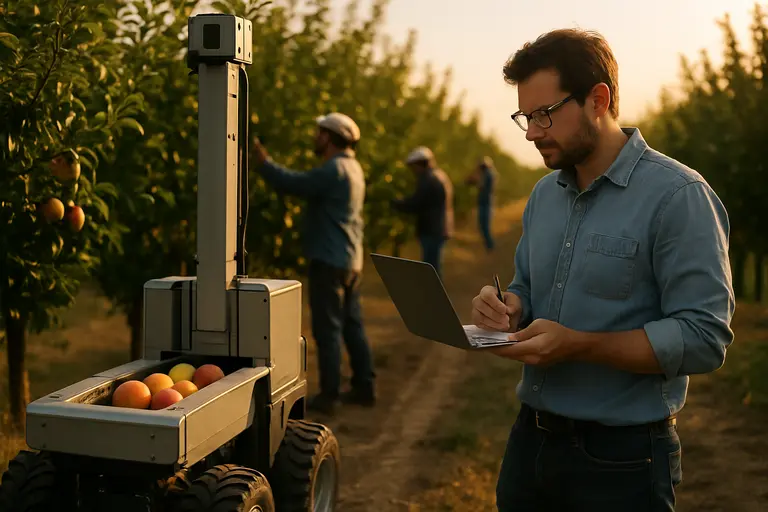
One Cornell-linked research direction is a robotic green fruitlet thinning system that combines machine vision, a soft robotic arm, and precision cutting tools. The system has had a working indoor prototype, but the field-testing window is narrow: about three weeks each spring. That detail is important because many orchard tasks are biologically constrained. Missing the proper thinning window can reduce the value of even a technically promising machine.
The same timing issue applies across the broader project. Pollination, thinning, harvest, and weed control each have different operating needs. A successful platform would need strong perception, safe movement, accurate actuation, and enough flexibility to justify its use across the season.
Weed Control Points To Related Automation Work
Cornell undergraduates also won the grand prize in The Farm Robotics Challenge on May 21, 2026, for an autonomous weed-killing robot for orchards and vineyards. The system used pulsed electricity at about 30 joules per plant, with total energy use reported at less than 0.1 kWh for 10,000 plants. That student project was separate from the Center of Excellence announcement, but it reflects the same broader push toward targeted field operations.
Previous Cornell work also included PhytoPatholoBot, reported in September 2025, an autonomous ground robot for near-real-time disease scouting in vineyards. The reported accuracy was comparable to expert human scouts, and the robot was deployed across ten Cornell pathology vineyards and several commercial sites. These examples show that automation research around specialty crops is not limited to harvest machines.
Adoption, Training And Community Fit
Skills May Become A Bottleneck
Precision farming tools often shift labor needs rather than remove them. If robots enter orchards, farms may need workers who can operate machines, interpret sensor output, troubleshoot field issues, and coordinate robotic tasks with hand crews. That skills question connects with broader coverage of AI and robotics training in U.S. smart farming.
Training needs are not a minor issue. A farm that cannot maintain or supervise a machine may see less benefit than expected. Service models, operator education, and clear safety protocols will influence whether orchard robots stay in research plots or become part of commercial routines.
Grower Fit Will Vary By Farm
Adoption will likely differ by crop, acreage, tree system, and local labor market. High-density apple orchards may offer more predictable geometry than older blocks, but that does not mean every high-density orchard will be an easy match. Ground conditions, slope, canopy management, and row spacing can all affect robotic performance.
That is why Cornell’s inclusion of social and economic research is significant. Engineering progress alone will not settle the question. Growers need evidence on costs, labor effects, fruit quality, machine downtime, and seasonal fit. Without those measures, efficiency claims remain incomplete.
Cornell’s Orchard Robotics Initiative
A Practical Signal For Specialty Crops
Cornell’s initiative is best read as a structured test of Orchard Robotics rather than a declaration that automation has solved orchard labor constraints. The funding, partner network, and research scope make the project one of the more notable U.S. specialty crop robotics efforts announced in 2026, but the hard work now shifts to field validation.
The strongest case for the project is its focus on repeated, labor-intensive tasks that fit real grower concerns. The main caution is that orchards present a difficult operating environment, and biological timing leaves little room for slow troubleshooting during critical windows.
If Cornell and its partners can show that multi-purpose systems work reliably across pollination, thinning, harvesting, weed control, or monitoring, the efficiency gains could be meaningful for some growers. If not, the research may still produce useful components, data methods, and lessons for future specialty crop automation. For now, the value of the initiative rests on measured field results, cost analysis, and grower confidence rather than on the promise of automation alone.