Record diesel prices are forcing the U.S. government to take an unusual step as farmers enter one of the most fuel-intensive periods of the agricultural calendar. On October 5, 2026, President Donald Trump signed an executive order directing federal agencies to expand access to dyed diesel and defer certain federal diesel fuel tax obligations through the end of the year.
The move comes as the national retail diesel price reached $6.36 per gallon on October 2, according to the U.S. Energy Information Administration’s latest available data. That price is creating an immediate problem for farmers harvesting corn, soybeans and other crops because fuel is being consumed by combines, tractors, grain dryers, irrigation equipment and trucks at the same time that crop transportation demand is rising.
The federal response is aimed at reducing the tax burden and improving access to lower-cost dyed diesel, but it does not solve the underlying shortage of refined fuel. That distinction is becoming increasingly important for agricultural producers because the price shock is being driven by supply conditions in addition to taxes.
Diesel Prices Have Reached A Critical Level For Harvest
Diesel is one of the most direct operating costs facing row-crop farmers during harvest. Combines can consume large amounts of fuel during long field days, while tractors, grain carts and trucks add additional demand as crops move from fields to elevators, storage facilities and processors.
The October 2 EIA data showed the U.S. average retail diesel price at $6.36 per gallon, compared with $4.38 for regular gasoline. Wholesale low-sulfur diesel was also elevated, reaching $4.67 per gallon at New York Harbor and $4.54 along the Gulf Coast.
That difference between wholesale and retail prices demonstrates that farmers are facing pressure throughout the fuel supply chain rather than at the retail pump alone.
The problem has become particularly severe in agricultural states. Louisiana Governor Jeff Landry said on September 23 that the state’s average diesel price had reached a record $6.03 per gallon, 112% above the price used by the LSU AgCenter when it developed its 2026 crop enterprise budgets.
For farmers operating thousands of acres, even a relatively small change in fuel consumption can therefore produce a significant change in total harvest expenses.
The Federal Government Is Expanding Access To Dyed Diesel
The executive order signed October 5 changes how federal authorities will treat dyed diesel during the current fuel-price emergency.
Dyed diesel, commonly called red diesel, is chemically similar to ordinary diesel but contains a dye that identifies it as fuel intended for uses generally exempt from federal highway fuel taxes. Farmers have traditionally used it in tractors, combines, irrigation equipment and other off-road machinery.
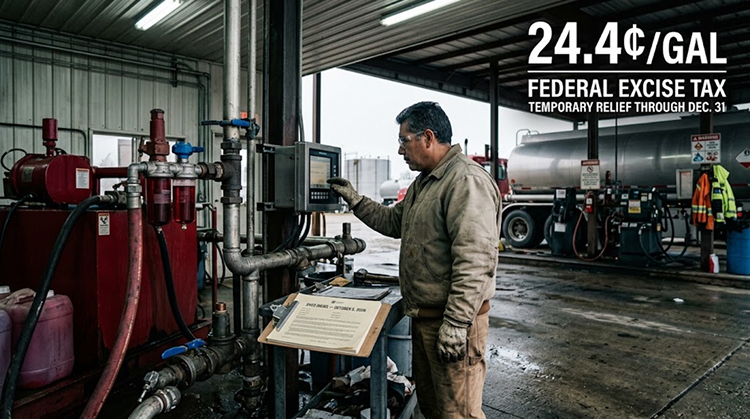
The new order directs the Treasury Department to determine whether certain federal tax-payment obligations can be deferred for qualifying users. If authorized, taxes incurred from October 5 through December 31, 2026 can be deferred without penalties or interest. The order also directs the Internal Revenue Service not to impose certain penalties related to dyed diesel sold for or used on highways during that period.
The White House diesel relief order also instructs the Agriculture Department to work with agricultural cooperatives, rural fuel distributors, farm-supply organizations and other industry groups to improve dyed-diesel distribution in areas experiencing high demand.
That makes the measure broader than a simple tax announcement. It is also an attempt to improve the physical availability of lower-cost fuel during harvest.
Farmers Could See Immediate Savings On Fuel Taxes
The federal diesel excise tax is 24.4 cents per gallon. The White House estimates that the federal portion alone represents roughly $60 on a 250-gallon fill. If states adopt comparable policies, the total savings could be larger.
For a farmer running equipment that consumes several hundred gallons during a long harvest day, the savings can accumulate quickly.
Consider a hypothetical 300-gallon fuel requirement. At 24.4 cents per gallon, the federal tax component would equal $73.20. A farm using 300 gallons per day for 30 harvest days would consume 9,000 gallons, producing a potential federal tax difference of $2,196 if the full amount qualified.
The actual benefit will depend on how the federal deferral is implemented, which fuel purchases qualify, and whether individual states provide corresponding relief.
That distinction is important because the executive order does not simply erase every diesel tax obligation nationwide. It establishes a temporary federal framework and directs agencies to use available legal authority to provide relief.
Harvest Operations Are Particularly Vulnerable To Diesel Costs
The timing of the diesel shock makes the problem more severe.
Farmers cannot simply reduce fuel consumption in proportion to the price increase. A combine still has to travel through the field, grain must be moved to trucks or bins, and trucks must transport that grain to elevators, ethanol plants, feed mills or processors.
Harvest also compresses fuel demand into a relatively short period.
A farmer may use relatively little diesel during certain months but consume enormous volumes during several weeks of harvesting. That makes the current price spike particularly damaging because producers are exposed when fuel requirements are at their seasonal peak.
This is where farm energy planning becomes increasingly important. Farmers can adjust routes, coordinate grain transportation, reduce unnecessary machine hours and optimize field operations, but the basic energy requirement of harvesting remains difficult to eliminate.
The current fuel shock therefore creates an economic problem that is larger than the price displayed at a filling station.
Louisiana Shows How State Governments Are Responding
Federal action follows several state-level responses to the diesel crisis.
Louisiana provides one of the clearest examples. On September 23, Governor Jeff Landry issued an executive order allowing certain farmers and timber harvesters to use dyed diesel in specified vehicles during the peak harvesting period.
The Louisiana order temporarily suspended penalties through October 22 for certain Class 2 forest-product and Class 5 farm-use vehicles. It also directed state officials to seek federal penalty relief from the IRS.
The state’s action shows why federal coordination matters.
A farmer can have access to dyed diesel on the farm but still face restrictions when moving equipment or agricultural products on public roads. The federal order attempts to reduce that regulatory friction while encouraging states to adopt corresponding policies.
The Louisiana agricultural fuel response also identified another major issue: U.S. distillate fuel inventories were 12.5% below the five-year average at the time of the state’s announcement.
That inventory deficit helps explain why tax relief alone cannot guarantee lower pump prices.
USDA Estimates The Farm Sector Could Save $640 Million
The U.S. Department of Agriculture immediately connected the federal action to the 2026 harvest.
Agriculture Secretary Brooke Rollins said October 5 that the action is expected to represent approximately $640 million in combined federal and state savings across about 224.6 million harvested acres.
That estimate places the fuel issue in a much larger agricultural context. Spread across the USDA’s cited harvested acreage, $640 million represents roughly $2.85 per harvested acre in combined savings on average.
The figure will not be distributed evenly. Fuel consumption varies substantially between corn, soybean, cotton, rice, specialty-crop and livestock operations. Irrigated farms can also have significantly different fuel requirements from dryland operations.
Still, the USDA estimate demonstrates the scale of the policy response.

The USDA agriculture announcement also emphasizes the timing of the policy, with farmers attempting to deliver the 2026 harvest while fuel costs remain unusually high.
Fuel Taxes Are Only Part Of The Price Problem
The biggest limitation of the federal measure is that taxes are only one component of diesel prices.
The EIA’s October 2 data showed crude oil prices, wholesale diesel prices and retail diesel prices all operating at elevated levels. New York Harbor low-sulfur diesel stood at $4.67 per gallon before distribution and retail costs were added.
The White House has attributed the broader fuel problem to restricted global diesel supply, while Reuters reported that disruptions connected to the Iran conflict, attacks on Russian refinery infrastructure and refinery constraints have affected refined-fuel markets.
This means removing or deferring the federal diesel tax can reduce the final cost, but it cannot create additional refinery capacity or immediately increase global supplies of diesel.
That is why farmers should view the order as temporary cost relief rather than a solution to the fuel market itself.
Refinery Capacity Is Becoming A Bigger Agricultural Issue
Agriculture depends heavily on refined petroleum products, making refinery disruptions a direct farm-sector concern.
Crude oil has to be processed into diesel before it can power combines and trucks. When refining capacity becomes constrained, crude availability does not necessarily translate into adequate diesel supplies.
The current market has exposed this vulnerability.
Reuters reported that the global diesel market has been affected by disruptions involving Russia and Iran, while the U.S. has also faced refinery-related limitations.
The agricultural consequences can extend well beyond fuel purchases. Higher diesel costs raise the expense of moving fertilizer, crop inputs, grain, livestock feed and finished agricultural products.
Transportation companies can also pass higher fuel expenses into freight rates.
That means a diesel shortage can increase costs at several points between the farm and the consumer.
Grain Transportation Could Absorb Part Of The Relief
The benefit to farmers will also depend on how much fuel is used to transport harvested crops.
Corn and soybeans frequently move by truck from farms to local elevators, ethanol facilities, feed operations and rail terminals. Some grain then moves long distances by rail or barge.
Every transportation leg adds fuel exposure.
If lower-cost dyed diesel becomes available for qualifying highway use under the temporary federal framework, some of the savings could reach agricultural trucking operations as well.
That could matter during the busiest weeks of the corn and soybean harvest, when trucks compete for limited loading and unloading capacity.
However, transportation companies still face maintenance, labor, insurance, equipment and financing expenses. Diesel is a major cost, but it is not the only cost determining freight rates.
Farmers Still Face High Fuel Costs Despite The Order
The federal action does not immediately return diesel prices to historical levels.
At $6.36 per gallon, the national average reported by EIA on October 2 remains far above the levels embedded in many farm budgets. The policy can reduce the tax component, but farmers will still be purchasing fuel in a market affected by crude oil prices, refinery capacity, inventories and transportation costs.
This creates a difficult calculation for producers already managing tight margins.
A farmer who expected diesel to cost $3.00 or $4.00 per gallon cannot simply absorb a price above $6 without changing the economics of field operations.
The difference can influence decisions about drying grain, hauling distance, custom harvesting, storage and the timing of crop sales.
The policy therefore arrives at a point when farmers have very little flexibility to postpone fuel-intensive activities.
The 2026 Harvest Will Test The Value Of Fuel Relief
The effectiveness of the federal diesel action will become clearer during the next several weeks.
The first test will be availability. If farmers and rural fuel distributors can obtain dyed diesel reliably in high-demand areas, the policy could provide meaningful relief during harvest.
The second test will be price transmission. If the tax savings appear in actual farm fuel prices, producers will see a direct reduction in operating expenses. If refined-fuel shortages remain the dominant driver, pump prices could stay elevated despite the tax change.
The third test will be state participation. The federal government is encouraging states to adopt corresponding policies, but state rules and taxes remain separate from federal requirements.
These three factors will determine whether the executive order produces a noticeable improvement on farms or mainly reduces one component of a much larger fuel-price problem.
Diesel Has Become A Farm Margin Issue
The diesel crisis has moved beyond the question of whether fuel is expensive. It is now influencing the economics of the 2026 harvest itself.
Farmers are operating combines and tractors when fuel consumption is at its seasonal maximum. Truckers are moving crops at the same time. Grain elevators, processors and ethanol plants are receiving large volumes of agricultural commodities. Every part of that chain depends on diesel-powered transportation and equipment.
The October 5 executive order gives the agricultural sector temporary relief by expanding access to dyed diesel and deferring certain federal tax obligations through December 31.
But the larger market remains dependent on refined-fuel supply.
The EIA petroleum market data will therefore remain an important indicator for farmers through the remainder of harvest. If diesel inventories recover and refinery operations stabilize, the tax relief could reinforce a broader decline in prices. If refined-product supplies remain tight, farmers could continue facing unusually high fuel costs even after the federal tax burden is reduced.
For the 2026 harvest, that distinction could determine whether the government’s emergency diesel policy becomes a meaningful reduction in farm expenses or simply a temporary buffer against a much larger energy-market shock.