The U.S. agricultural sector is entering the second half of the 2026 growing season under a weather signal that has few recent comparisons. July 2026 became the hottest month ever recorded for the contiguous United States, with a national average temperature of 76.89°F, according to NOAA data released in August. The record surpassed the previous July benchmark from the Dust Bowl era in 1936. All 48 contiguous states recorded temperatures at least 1°F above their 20th-century averages.
The significance for agriculture goes beyond a single monthly temperature record. Heat affects crop development, soil moisture, irrigation demand, livestock conditions and the timing of harvest operations. The geographic footprint of the July heat also matters. NOAA reported the strongest conditions across portions of the Mountain West, Southwest, Northern Plains and Southeast, creating different agricultural risks across major production regions.
For U.S. farmers, the 2026 growing season is therefore developing around two competing realities. Modern agriculture has better genetics, irrigation systems, weather information and field-level monitoring than previous generations. At the same time, extreme heat can arrive during sensitive crop-development windows when even well-managed farms have limited options.
July 2026 Breaks A National Temperature Record
NOAA’s August climate assessment established July 2026 as the warmest month in the historical record for the contiguous United States, which extends back to 1895. The 76.89°F national average surpassed the previous record set during July 1936, a period associated with severe Dust Bowl conditions.
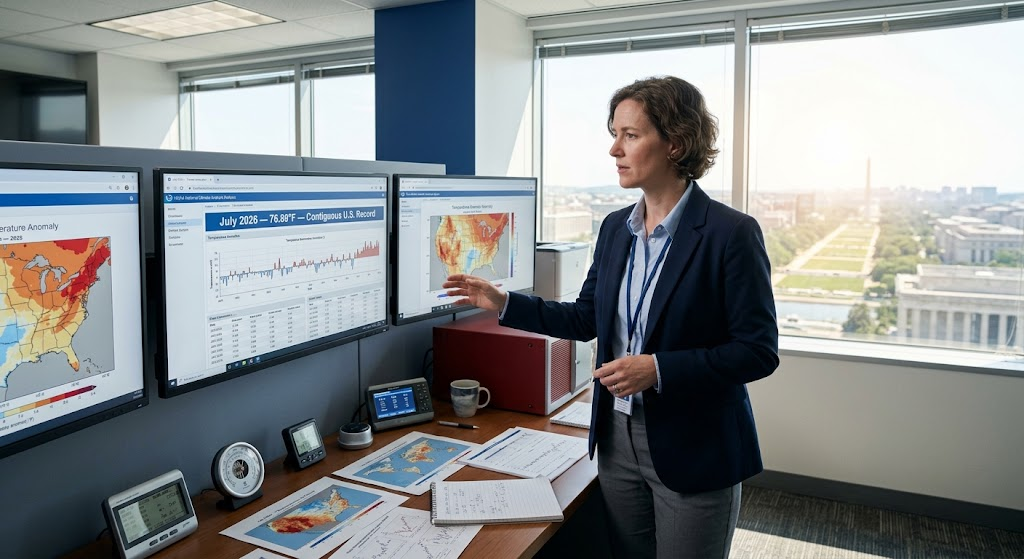
The comparison with 1936 is useful, but the agricultural circumstances are very different. Farms today have access to irrigation technology, improved crop genetics, conservation practices, crop insurance, satellite observations and detailed weather forecasts that were unavailable during the Dust Bowl.
Yet the basic biological relationship between temperature, water and crop growth has not changed.
Corn, soybeans, cotton, wheat, fruits and vegetables each have temperature ranges in which development is most efficient. When temperatures move substantially above those ranges, plants can experience greater water demand and physiological stress. The effect depends on crop stage, soil moisture, humidity, nighttime temperatures and the duration of the heat event.
NOAA’s July 2026 climate information provides the national historical context behind the record and allows agricultural analysts to compare current conditions with previous extremes.
| July 2026 U.S. Heat Indicator | Reported Condition |
|---|---|
| Contiguous U.S. average temperature | 76.89°F |
| Historical record beginning | 1895 |
| Previous July benchmark | 1936 |
| Contiguous states above 20th-century average | 48 of 48 |
| Major high-impact regions | Mountain West, Southwest, Northern Plains, Southeast |
The record is significant because it reflects a national average. Individual farm locations can experience much higher daytime temperatures, different humidity levels and different overnight cooling patterns.
Nighttime Heat Adds Another Agricultural Pressure
One of the most important characteristics of the 2026 heat event was the strength of overnight temperatures.
Hot afternoons receive most of the attention in agricultural discussions, yet nighttime conditions can influence how much time plants have to recover from daytime stress. When temperatures remain elevated after sunset, crops lose part of the cooling period that normally reduces physiological demand.
NOAA data and reporting on the July record indicate that unusually high nighttime temperatures played a major role in the national result.
This distinction matters for crops such as corn during reproductive development. High temperatures around pollination can affect pollen viability and synchronization between pollen release and silk development. Water shortages can intensify those effects. Soybeans have their own sensitivity to heat and moisture availability during flowering and pod formation.
A hot day followed by a relatively cool night is different from a sequence of hot days accompanied by warm nights.
That difference is difficult to capture with a single maximum-temperature number.
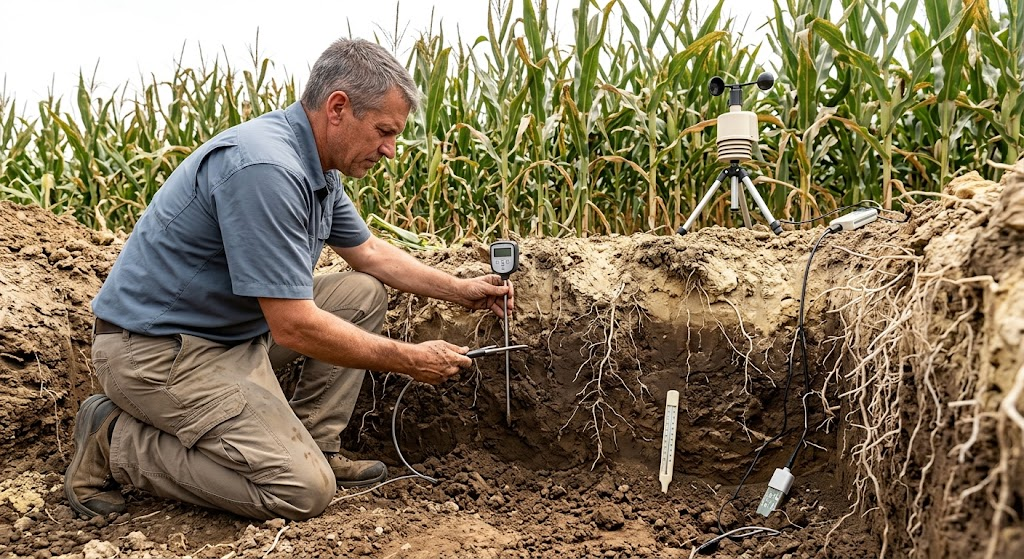
Farmers increasingly use soil-moisture sensors, local weather stations and field imagery to track those conditions at a much finer scale. A field with adequate water reserves may withstand a heat event better than a nearby field with shallow soil or depleted moisture.
The USDA Crop Progress data provide another layer of information by tracking crop development and condition across major producing states.
Corn Faces Heat Risk During A High-Value Growth Period
Corn is one of the clearest examples of why timing matters.
The 2026 U.S. crop was planted across approximately 95.3 million acres, according to USDA’s June 30 Acreage report. USDA estimated that farmers expected to harvest 87.4 million acres for grain, down 4% from 2025.
Those acres represent an enormous economic investment in seed, fertilizer, machinery, fuel, land and labor.
The same USDA report showed 5.29 billion bushels of corn stocks on June 1, 2026, up 14% from a year earlier. That inventory provides some supply protection for the market, but it does not remove the importance of the 2026 crop’s final yield.
Heat risk becomes more consequential when a large number of acres are simultaneously reaching sensitive stages.
The impact can vary considerably across Iowa, Illinois, Indiana, Nebraska, Minnesota and other Corn Belt states. Rainfall distribution can change over short distances. Soil texture can influence how long moisture remains available. Irrigated acreage has another layer of protection, though irrigation capacity is itself limited by water availability, infrastructure and pumping costs.
For farmers, the question is therefore less about whether the United States experienced record heat and more about where the heat occurred, how long it lasted and what soil moisture was available at the time.
Soybean Fields Face A Different Heat Equation
Soybeans respond differently to temperature stress than corn, yet moisture and heat remain closely connected.
The USDA estimated 85.4 million soybean acres planted in 2026, 5% above 2025. Harvested soybean acreage was projected at 84.4 million acres, also up 5%.
That increase gives soybean production a large acreage base, but acreage alone cannot guarantee a strong harvest.
Soybean development during flowering and pod formation depends on adequate water and favorable temperatures. Prolonged heat can increase evapotranspiration, causing plants to draw moisture from the soil more quickly. If rainfall fails to replenish that supply, the crop can move from mild stress into more serious yield pressure.
This is one reason precision agriculture has become increasingly relevant to heat management.
Agheiro’s precision farming coverage examines technologies that help producers identify differences between fields and management zones rather than treating every acre as identical.
Satellite imagery, soil-moisture measurements and variable-rate irrigation can help identify areas where crops are under greater stress. Those tools do not eliminate weather risk, but they can give producers more information before applying water or making other management decisions.
Heat And Soil Moisture Are Closely Connected
Temperature records tell only part of the agricultural story.
A farm can experience extreme heat without severe crop damage if soil moisture is abundant and roots can access that water. A less extreme temperature event can produce greater damage when soils are already depleted.
This relationship is especially important across the Great Plains and western farming regions, where irrigation and stored soil moisture can determine whether crops maintain growth during extended hot periods.
The USDA’s crop-progress system provides state-level information on crop condition, soil moisture and development. Its graphical products compare current crop conditions with previous years and five-year averages.
That comparison can reveal whether a national weather event is translating into a measurable deterioration in crop condition.
The geographic differences are substantial.
An Iowa cornfield receiving regular rainfall operates under a different water balance than an irrigated Nebraska field drawing from groundwater. A dryland Kansas farm has a different risk profile again. California specialty crops face different heat and irrigation requirements than Midwestern row crops.
A national heat record should therefore be treated as an indicator of elevated risk rather than a direct estimate of crop losses.
Irrigation Systems Face Greater Demand
Higher temperatures can increase agricultural water demand even when planted acreage remains unchanged.
When temperatures rise, crops generally lose water more quickly through evapotranspiration. Farmers using irrigation may need to increase application frequency or adjust timing to maintain crop conditions.
That creates several practical limits.
Groundwater wells have pumping capacities. Surface-water supplies depend on reservoirs, rivers and allocation rules. Irrigation equipment has finite application rates. Energy costs can affect how aggressively producers run pumps. In some areas, water restrictions can prevent farmers from applying all the water a crop might require.
The 2026 heat event places these constraints into sharper focus.
The issue is especially significant in western agriculture, where irrigation accounts for a substantial share of crop production. Almonds, pistachios, vegetables, cotton, rice and other crops can depend heavily on carefully managed water supplies.
Heat therefore creates a connection between weather, water policy and farm economics.
A farmer may have sufficient water rights but still face higher pumping costs. Another producer may have modern irrigation equipment but insufficient available water. A third may use soil sensors to improve application efficiency but still face an extended period of atmospheric demand that exceeds available supply.
Specialty Crops Face Different Exposure
The national heat record also has implications for fruit, vegetable and specialty-crop producers.
Specialty crops can have narrow quality standards. Heat can influence fruit size, color, firmness, flowering, pollination and harvest timing. Even when plants survive, extreme temperatures can affect marketable quality.
California is particularly important in this discussion because of its role in U.S. specialty-crop production.
The state already operates under complex water-management conditions, including competition among agriculture, urban users and environmental requirements. High temperatures can increase crop water requirements at the same time that water managers face pressure from drought and limited supplies.
The 2026 national heat record does not mean every California farm experienced its most severe conditions in July. In fact, California’s statewide July average was high but did not set the same national-type record.
That distinction reinforces the importance of regional analysis.
Livestock Producers Face Heat Stress Too
The agricultural risk created by extreme heat extends beyond crops.
Cattle, dairy cows, poultry and other livestock can experience reduced feed intake, lower productivity and increased heat stress during prolonged high temperatures. Producers may need to increase access to shade, water, ventilation and cooling systems.
Dairy operations can be particularly sensitive because heat stress can affect milk production and animal health.
Pasture-based cattle operations face another concern: heat and dry conditions can reduce forage growth at the same time that animals require more water.
The result is a potential cost increase on both sides of the farm balance sheet.
Feed demand does not disappear during hot weather. If crop yields decline, livestock producers can face higher feed costs. If pasture conditions deteriorate, more animals may require supplemental feed. These relationships connect weather conditions with corn and soybean markets.
Precision Agriculture Becomes A Risk-Management Tool
The 2026 heat record gives precision agriculture a more practical role in farm management.
Farmers have access to technologies capable of identifying variation within individual fields. Satellite imagery can identify changes in vegetation. Soil probes can measure moisture at different depths. Weather stations can provide field-specific temperature and humidity observations. Yield monitors can later compare expected conditions with actual harvest results.
USDA’s NASS has expanded access to geospatial crop-progress and condition datasets covering corn, soybeans, cotton and winter wheat. The datasets provide synthetic representations of confidential county-level information and cover growing seasons from 2015 through the present.
This type of information can help researchers and producers study how crop conditions respond to weather patterns.
The key value is spatial detail.
A national temperature average cannot tell a farmer which section of a 500-acre field needs attention. A combination of field sensors, imagery and weather observations can provide a much more localized view.
That does not turn agriculture into a fully predictable system. Weather remains uncertain, and biological responses differ among varieties, soils and management systems. Better information can, though, reduce the amount of decision-making based solely on broad regional averages.
The 2026 Heat Record Changes The Risk Conversation
The agricultural significance of July 2026 is larger than a single temperature statistic.
The contiguous United States averaged 76.89°F, setting a national monthly record and surpassing the previous benchmark from 1936. Every contiguous state finished at least 1°F above its 20th-century average.
At the farm level, the consequences will depend on crop type, growth stage, soil moisture, irrigation access and the duration of exposure.
For corn producers, heat during reproductive development can affect yield potential. For soybean growers, water availability during flowering and pod formation remains a major factor. Specialty-crop producers must balance plant health with quality requirements. Livestock operators face heat-stress concerns that can translate into higher management costs.
The record also comes at a time when U.S. agriculture has become more data-driven. Farmers have more tools for measuring field conditions than ever before, yet those tools cannot create rainfall or reduce atmospheric temperatures.
The next phase of the 2026 growing season will reveal how much of the national heat signal becomes measurable production loss. USDA’s weekly crop-progress reports, state-level soil-moisture observations and later production estimates will provide increasingly clear evidence.
For agricultural markets, the central question is no longer simply whether 2026 was unusually hot. The more consequential question is how efficiently U.S. farms converted available water, acreage and growing-season time into marketable production under that heat.
That answer will vary from field to field, but the July record has established a new benchmark against which the rest of the 2026 crop season will be measured.