The 2026 U.S. corn harvest entered September with an early advantage over the historical pace, but a prolonged stretch of heavy rain is now slowing fieldwork across important parts of the Corn Belt. USDA reported that 13% of the nation’s corn crop had been harvested by September 20, compared with 11% for the five-year average and 10% last year. At the same time, 92% of corn in the 18 major producing states had reached the dented stage and 58% had reached maturity. (USDA Crop Progress data)
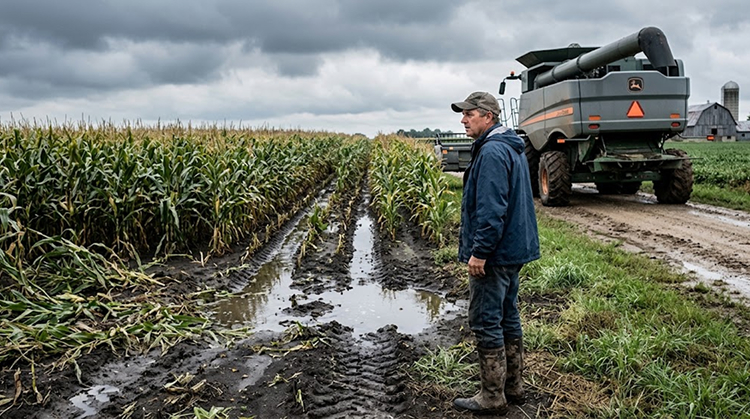
The national numbers still show a harvest running ahead of normal, but they conceal a widening regional difference. In Iowa, one of the country’s most important corn-producing states, farmers had only 1.7 days suitable for fieldwork during the week ending September 20. Corn harvest reached just 4%, three percentage points behind the same point last year, while heavy rainfall created flooding in some areas. Iowa Secretary of Agriculture Mike Naig described the week as “extremely soggy” and said farmers were waiting for fields to firm before getting combines fully moving.
That contrast is becoming one of the defining features of the 2026 harvest. Some areas are already moving significant quantities of grain, while others are temporarily unable to enter fields.
The National Harvest Is Still Ahead Of Average
At the national level, the harvest has not yet fallen behind schedule.
USDA’s September 21 Crop Progress report showed 13% of corn harvested, two percentage points ahead of the five-year average and three points ahead of last year. The report covered 15 of the 18 top corn-producing states, meaning harvest activity is already widespread even though progress varies sharply from state to state.
Corn maturity is also ahead of the historical pace. USDA estimated that 58% of the crop had reached maturity, compared with 55% for the five-year average. That provides farmers with a substantial amount of grain that is biologically ready for harvest once field conditions permit equipment to enter.
The distinction between crop maturity and harvest progress is becoming increasingly important.
A mature corn field does not guarantee that farmers can harvest it immediately. Soil moisture, standing water, rutting risk, equipment traction and grain moisture all influence whether a producer can safely put a combine into a field.
The current situation therefore creates a temporary disconnect between what the crop is ready to do and what farmers are physically able to do.
The latest USDA Crop Progress reports will be particularly important over the next several weeks because the national percentage harvested could change quickly if dry weather returns.
Iowa Is Showing How Quickly Rain Can Change Harvest Conditions
Iowa provides one of the clearest examples of the current problem.
The state’s September 21 crop report showed that only 1.7 days were suitable for fieldwork during the previous week, compared with 4.9 days during the same week last year. Topsoil was rated 68% adequate and 28% surplus, while subsoil was 69% adequate and 18% surplus.
Corn development was relatively advanced. Ninety-five percent of Iowa’s crop had reached the dent stage, while 56% had reached maturity. Yet only 4% had actually been harvested.
The result is a large amount of mature corn waiting for an opportunity to move from the field.
Iowa State University Extension reported September 22 that persistent rainfall had brought fieldwork to a standstill across much of the state. Field agronomists were also beginning to watch for corn standability, ear rots and grain-quality problems as wet conditions continued. In northwest Iowa, some early grain harvest had already started before the rain, and farmers in several areas reported better-than-expected yields.
The situation illustrates why statewide harvest statistics can be misleading. A state can have excellent crop conditions and strong yield potential while still struggling to physically remove grain from fields.
The Wet Pattern Has Spread Across The Corn Belt
Iowa is not experiencing the problem alone.
Heavy rainfall affected parts of Iowa, Illinois, Minnesota and Ohio during the week ending September 20. Pro Farmer reported that areas of eastern Iowa, northeast Indiana and central Ohio had already recorded their wettest September to date, while a region stretching across southeast Minnesota, southwest Wisconsin, northwest Illinois and northeast Iowa received more than 7 inches of rain during the month.
Those totals are significant because September is normally a critical transition period for Midwestern agriculture.
Farmers need enough dry weather for combines and grain carts to operate, but they also need grain to reach appropriate moisture levels. Excessive rainfall can interrupt both processes.
Rain also does not affect every farm equally. Fields with heavier soils or poor drainage can remain inaccessible long after rainfall stops. Well-drained fields may become workable sooner, creating a patchwork harvest pattern within the same county.
That makes the current weather situation more than a simple question of how much rain has fallen.
The timing, intensity and location of the rainfall are just as important.
Illinois And Missouri Are Moving At Very Different Speeds
State-level data shows just how uneven the harvest has become.
Illinois had reached 8% corn harvested, according to the September 21 regional crop update, twice the five-year average. Missouri was considerably further ahead at 23%, compared with a normal pace of about 13%. Indiana, meanwhile, was still moving through crop maturity, with 32% of its corn mature.
The differences reflect more than rainfall.
Planting dates, temperature patterns, soil types and crop development all affect when farmers can begin harvesting. Southern states generally begin earlier than northern Corn Belt states, while individual fields can vary significantly depending on planting and weather.
Missouri’s 23% harvest therefore provides a useful reminder that the national average is being lifted by regions where combines are already moving efficiently.
At the same time, Iowa’s 4% harvest shows why the national number should not be interpreted as a uniform picture of the Corn Belt.
The market ultimately cares about the total volume of corn entering the supply chain, but farmers and local grain elevators have to deal with conditions at the county level.
Wet Fields Create More Than A Temporary Scheduling Problem
The most obvious consequence of rain is lost field time.
But the agricultural cost can extend beyond a few days of delay.
Heavy equipment operating on saturated soils can create deep ruts and compact soil. Producers may therefore choose to wait rather than risk long-term damage to fields.
That decision can make economic sense even when a combine is technically capable of entering a field.
Soil compaction can affect root development, water movement and future field operations. Damage created during a wet harvest may remain long after the corn has been removed.
The Iowa State University Extension crop update is already highlighting these concerns, including soil conditions and the potential effect of persistent wet weather on harvest operations and crop quality.
Farmers are therefore balancing two competing priorities: harvesting mature corn before additional weather creates losses, while avoiding unnecessary damage to the land and equipment.
That decision becomes more difficult when the forecast offers only short dry windows.
Grain Quality Could Become A Bigger Concern
Harvest delays can also affect grain quality.
Corn that remains standing in wet conditions is exposed to continued weathering. Depending on temperature, humidity, plant health and ear condition, prolonged wet weather can increase the risk of ear rots and other quality problems.
Iowa State University Extension specifically identified ear rots and grain quality as emerging concerns in its September 22 update.

Grain quality matters because farmers do not receive the same price for every bushel.
Moisture discounts, test-weight issues, damaged grain and other quality deductions can reduce the value of harvested corn even when yields are strong.
This makes the current weather situation particularly important for producers who were expecting to benefit from strong field performance.
A high-yielding crop can still generate disappointing returns if excessive moisture increases drying costs or quality discounts.
Early Harvest Progress Has Given Farmers Some Cushion
The current delays would be more concerning if the entire country had entered September behind schedule.
That is not what happened.
National corn harvest was already ahead of the five-year average before the latest rainfall event. Crop maturity was also ahead of normal, giving farmers a relatively large amount of corn that was close to harvest readiness.
This early progress provides some cushion.
Farmers in drier regions have already removed grain, while other areas wait for conditions to improve. The national market therefore has more physical corn available than the Iowa harvest number alone would suggest.
That helps explain why the current rainfall has not immediately transformed the national supply picture.
Still, the cushion can shrink if wet weather persists.
A week of lost fieldwork is manageable. Repeated wet weeks during October can create a very different situation, especially if temperatures fall and drying conditions deteriorate.
The Weather Divide Is Becoming More Pronounced
The Corn Belt is not experiencing one uniform weather pattern.
Pro Farmer’s September 21 analysis described an agricultural region increasingly divided between wetter conditions in the western and central Corn Belt and potentially more favorable harvest windows farther east. Meteorologist Matt Griffin of BAM Weather said the Western Ag Belt could face continued issues while the Eastern Ag Belt may find better opportunities for fieldwork.
That regional divide could become increasingly important as the harvest expands.
Farmers in eastern Illinois, Indiana and Ohio may be able to take advantage of drying conditions while producers farther west continue waiting for soils to firm.
The result could be a harvest that progresses in waves rather than at a consistent national pace.
For grain markets, that creates transportation and storage challenges as well.
Elevators receiving large quantities from one region may face temporary capacity pressure while other facilities remain relatively quiet.
Transportation Will Become More Important As Fields Dry
Once the rain stops, farmers will need to move quickly.
Combines, grain carts, trucks, elevators, dryers and rail systems all become interconnected during harvest. A sudden return to dry weather can generate a surge in grain deliveries.
That can create bottlenecks even when crop production itself is proceeding normally.
The transportation issue is particularly important in 2026 because farm fuel costs remain unusually high. National on-highway diesel prices reached a record $6.285 per gallon on September 14, according to EIA data, increasing the cost of running machinery and moving grain.
For farmers already dealing with weather delays, a compressed harvest window can therefore become more expensive.
Several days of idle equipment followed by extended operating hours can increase fuel use, labor requirements and machinery wear.
The economics of the harvest depend on how efficiently producers can convert the available field days into completed acres.
Corn Yield Expectations Are Still Being Tested
The weather delays are occurring at the same time that the market is trying to determine how closely actual yields will match USDA’s forecasts.
USDA’s September 11 Crop Production report reduced the 2026 national corn yield forecast to 178.5 bushels per harvested acre, down from 180.7 bushels in August. Production was projected at approximately 15.8 billion bushels.
Harvest results will now provide increasingly important evidence.
Early reports from some parts of Iowa have indicated yields above expectations, according to Iowa State University Extension, but those observations are regional and cannot be treated as representative of the entire U.S. crop.
The market will need thousands of additional fields harvested before a reliable picture of national yield emerges.
That makes every week of harvest data more important.
If yields confirm the September USDA forecast, attention will return to demand and global supply. If actual yields are materially lower or higher, the domestic balance sheet could change again.
Global Corn Demand Makes Harvest Timing More Important
The weather story is also connected to the broader global corn market.
Recent market analysis has projected global corn consumption above production during the 2026/27 marketing year, creating greater attention around the amount of corn available from major exporters.
That means the United States has an important role in maintaining global supply.
The U.S. crop remains very large even after USDA reduced its production estimate, but international buyers are watching the pace at which American corn becomes physically available.
A delayed harvest does not necessarily reduce production.
It can, however, change the timing of when grain reaches elevators, processors and export channels.
That distinction matters in a market where buyers are watching both the total number of bushels and the timing of those bushels entering commercial supply.
Farmers May Need To Rethink Harvest Priorities
The current conditions are forcing farmers to make decisions that would not be necessary during a consistently dry harvest.
Some may prioritize fields with the greatest risk of lodging or quality deterioration. Others may choose better-drained fields first to avoid damaging saturated ground.
Machinery availability can also influence the sequence.
A farmer with multiple combines may be able to take advantage of short dry windows more effectively than a smaller operation relying on one machine.
Custom harvesting adds another variable because contractors may face competing demands across several farms.
These differences mean the impact of rainfall is distributed unevenly across farm operations.
There is no single harvest strategy that works across the entire Corn Belt.
The Next Dry Window Could Produce A Rapid Harvest Surge
The current slowdown does not mean the 2026 harvest will remain behind schedule.
If the Corn Belt receives several consecutive dry days, farmers can quickly increase harvesting activity.
Much of the crop is already mature or close to maturity. That means producers do not necessarily need another month of crop development before they can begin removing grain.
They need workable fields.
That distinction makes the next weather window particularly important.
A dry period could allow combines to operate for extended hours, quickly reducing the backlog created by September rainfall. Grain elevators and transportation networks would then have to absorb the resulting surge.
The opposite scenario is more complicated.
If rain continues at frequent intervals, farmers may repeatedly lose two or three days of fieldwork before gaining only a short window to operate.
That pattern would make the harvest progressively more difficult as October advances.
September Rain Is Testing The Early Harvest Advantage
The 2026 U.S. corn harvest is entering a critical transition.
Nationally, the crop remains ahead of average. USDA reported 13% harvested by September 20, compared with 11% for the five-year average. Corn maturity is also ahead at 58%, compared with 55% normally.
But the national figures do not capture the increasingly difficult conditions across parts of the Corn Belt.
Iowa had only 1.7 suitable fieldwork days during the week ending September 20 and had harvested 4% of its corn. Heavy rainfall produced surplus soil moisture and flooding in some areas.
Meanwhile, rainfall totals exceeding 7 inches were reported across portions of southeast Minnesota, southwest Wisconsin, northwest Illinois and northeast Iowa during the wet September pattern.
The result is a harvest divided between regions that can keep combines moving and regions waiting for fields to dry.
For American corn farmers, the next stage of the season will depend less on whether the crop is mature and more on whether the ground can support the machinery needed to remove it.
The early start has given the national harvest some breathing room, but September’s rain is now testing how much of that advantage remains. As October approaches, the difference between a short interruption and a prolonged harvest disruption will be determined by the next sequence of dry days, soil conditions and the quality of the corn waiting in the fields.