The U.S. soybean harvest has reached 17% completion, exactly matching the five-year average, but persistent rainfall across parts of the Midwest is creating a much tighter situation for processors that need soybeans immediately. USDA reported September 28 that soybean harvest had advanced from 12% a week earlier, while 75% of the crop had dropped leaves. The national crop was rated 58% good to excellent, four percentage points below the same point last year.
Those national numbers do not fully explain what is happening at individual crushing plants.
Reuters reported September 25 that soybean processors in the western Midwest were offering unusually large premiums for prompt deliveries because rain had delayed harvest and reduced the amount of newly harvested beans reaching elevators and processing facilities. Some plants operated by Cargill, Archer-Daniels-Midland, CHS Inc. and Shell Rock Soy Processing have faced tight supplies, while some facilities have reduced their crushing pace.
The immediate problem is therefore less about the total size of the 2026 soybean crop and more about where the soybeans are, when they can be harvested and how quickly processors need them.
That distinction is becoming increasingly important as U.S. soybean crushing capacity expands.
The National Harvest Has Returned To The Average Pace
The latest USDA numbers show why the processor shortage can be difficult to see from the national data alone.
As of September 27, 17% of U.S. soybeans had been harvested, compared with 18% a year earlier and 17% for the five-year average. A week earlier, only 12% had been harvested.
The crop is therefore moving forward.
But it is no longer running ahead of the historical pace, as it had earlier in September.
That change matters because processors operate continuously rather than waiting for the national harvest percentage to reach a particular threshold.
A crushing facility needs a dependable flow of soybeans every day. When local harvest is interrupted, an elevator can quickly run short even though millions of acres elsewhere remain unharvested.
The USDA Crop Progress report provides the national benchmark, but state-level harvest conditions provide a much clearer picture of whether processors can physically obtain the beans they need.
This is why the current market is showing unusually strong premiums for nearby soybeans.
Processors Are Paying More For Beans They Can Get Now
The most striking evidence of the shortage is appearing in local cash markets.
Reuters reported that Cargill was bidding $1 per bushel above November soybean futures for deliveries to its Sioux City, Iowa, crushing plant on Thursday or Friday. That translated into a cash price of approximately $14.17½ per bushel at the time. For Saturday delivery, the bid dropped to 15 cents below November futures.
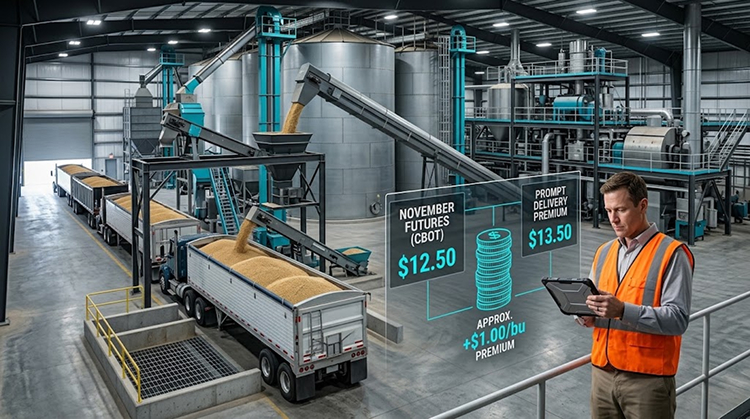
The rapid change in the bid demonstrates how much processors value immediate supply.
The difference between a soybean that can arrive at a crusher today and one that may not be available for several weeks has become unusually large.
Other processing facilities in Iowa and Minnesota operated by ADM, CHS and Shell Rock Soy Processing also offered short-term premiums.
In central and eastern regions, Bunge’s soybean facility in Decatur, Indiana, raised its bid by 20 cents to 25 cents over November futures for deliveries by Friday, according to Reuters.
This creates a market structure that can be very favorable for farmers who have harvest-ready soybeans and dry fields.
But it does little for producers whose crops are still standing in saturated ground.
Rain Is Slowing Both Harvest And Crop Dry-Down
The processor shortage is being intensified by the physical condition of fields.
Reuters reported that late-summer rainfall has left some fields too muddy to support harvesting equipment. Persistent moisture is also slowing the natural dry-down process of soybeans and delaying crop maturity in parts of Iowa and Indiana.
That creates several potential bottlenecks.
First, combines cannot operate efficiently on saturated ground.
Second, harvested soybeans may contain more moisture and require additional drying.
Third, repeated rainfall can make the next available harvest window shorter.
Fourth, farmers may prioritize fields with better drainage, leaving other acres waiting longer.
This is where crop marketing planning becomes especially important. Producers are not simply deciding whether to sell soybeans. They are deciding when they can physically harvest them, where they can deliver them and whether the premium offered by a particular processor compensates for transportation, drying and other costs.
Soybean Crushers Are Entering A Record-Scale Processing Year
The immediate shortage is especially significant because the U.S. soybean processing industry is operating with exceptionally strong demand.
USDA’s Economic Research Service projects 2.78 billion bushels of U.S. soybean crush for the 2026/27 marketing year, unchanged in its September outlook. U.S. soybean production is forecast at approximately 4.5 billion bushels, while exports are projected at 1.69 billion bushels. Ending stocks are forecast at 310 million bushels.
That creates a powerful demand base for domestic processors.
The expansion of crushing capacity in recent years has been driven in part by demand for soybean oil used in biofuel production.
More processing capacity means more facilities competing for available soybeans.
That competition can become particularly intense during the transition between old-crop and new-crop supplies.
Processors cannot simply shut down indefinitely while waiting for farmers to harvest.
Crushing plants have large fixed investments and require substantial volumes of soybeans to operate efficiently.
When local supplies tighten, the plants therefore have an incentive to bid aggressively for the beans that are available.
Iowa Farmers Are Facing A Supply Problem Inside Their Own Fields
Iowa illustrates the unusual nature of the current soybean market.
Reuters reported that farmer Roger Cerven of Montgomery County, southwest Iowa, recently sold his remaining old-crop soybeans and hauled them more than 50 miles to Bunge’s Council Bluffs, Iowa, processing facility. The plant was offering a 65-cent-per-bushel premium when he made the delivery, and that premium later increased to 85 cents for immediate deliveries.
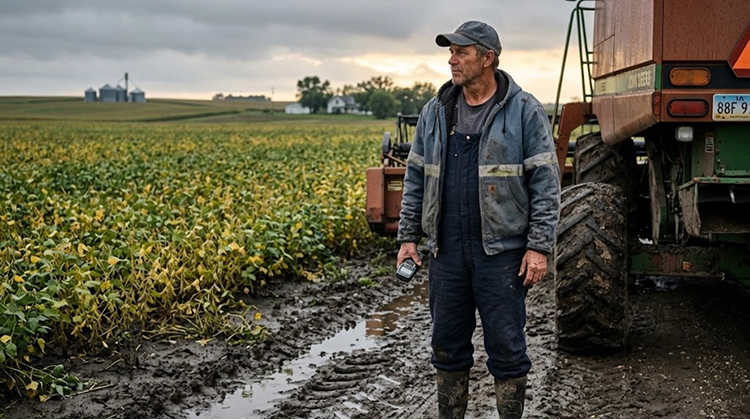
Cerven said farmers around him did not have soybeans available to sell because the new crop was still weeks away from harvest.
The problem was not a lack of soybeans in the region in an agricultural sense.
The beans existed.
They were simply still in the fields.
That distinction is critical for understanding basis markets.
A soybean farmer cannot take advantage of a record local basis if saturated soil prevents the combine from entering the field. The price signal is therefore strongest precisely when physical access to the crop is most difficult.
The result is an unusual situation in which farmers with old-crop inventory can benefit immediately while farmers waiting on the new crop may be unable to respond to the premium.
Biofuel Demand Is Changing The Economics Of Soybeans
The soybean market has changed significantly as demand for soybean oil has expanded.
A soybean is no longer simply a source of meal for livestock feed and oil for food products. Increasing demand for renewable diesel and other biofuel applications has made soybean oil an increasingly important component of the crushing industry’s economics.
That helps explain why USDA expects U.S. crush to reach 2.78 billion bushels in 2026/27.
For processors, the value of the soybean depends on what can be earned from both products.
The crush produces soybean meal, which is primarily used in animal feed, and soybean oil, which has become increasingly valuable in renewable fuel markets.
When soybean oil margins are attractive, processors have a stronger incentive to maintain or increase crushing activity.
That increases competition for beans.
The current harvest delay therefore arrives at a time when crushers already have strong reasons to keep plants supplied.
Some Crushing Plants Are Already Scaling Back
The shortage is no longer theoretical.
Reuters reported that some plants have already scaled back soybean crushing operations because they could not secure sufficient supplies. Cargill facilities in Cedar Rapids, Iowa; Iowa Falls, Iowa; and Sioux City, Iowa, reportedly did not post soymeal offers because of the lack of soybean supplies.
That development reaches beyond farmers.
Soymeal is a major protein source for livestock and poultry producers.
If processors reduce crushing, the immediate effect is not simply fewer soybean bushels processed. It can also reduce the availability of soybean meal and alter regional feed markets.
The resulting price signals can move through multiple agricultural sectors.
Hog and poultry producers may pay more for meal if local supplies become tighter. Feed manufacturers may adjust sourcing. Processors may attempt to bring soybeans in from farther away.
The soybean harvest delay can therefore affect livestock economics even before the national harvest falls significantly behind schedule.
Soymeal Prices Are Showing The Same Physical Tightness
The pressure has already reached the futures market.
Reuters reported that October soybean meal futures surged to a contract high and traded at an unusual premium to December contracts. The inverse structure was the first of its kind in more than two years, according to the report.
An inverse market structure can indicate that buyers are placing greater value on immediate supply than on later deliveries.
That fits the physical story.
Processors need soybeans now.
They cannot replace today’s missing beans with a crop that might be harvested several weeks later.
The same principle applies to soybean meal.
If processors reduce crushing because they cannot obtain enough beans, meal supplies can tighten at precisely the time livestock producers need regular feed deliveries.
This creates an unusual chain:
Rain delays harvest → soybean deliveries decline → processors compete for nearby beans → crushing becomes harder to maintain → soybean meal availability tightens.
The longer the weather disruption lasts, the more important that chain becomes.
Indiana Is Showing The Problem Beyond The Western Midwest
The shortage is not confined to Iowa.
Reuters reported that excessive rainfall across central Indiana has made fields muddy and prevented farmers from harvesting. Local producers said heavy August rainfall left crops saturated and slowed natural dry-down, pushing some crop maturity back by several weeks.
That matters because Indiana is an important soybean-producing state and contains significant processing capacity.
The problem is therefore developing across both the western and eastern parts of the Midwest.
The latest USDA soybean market outlook projects a very large U.S. soybean crop, but the current processor market demonstrates why annual production estimates cannot explain short-term cash prices by themselves.
The physical movement of soybeans matters just as much.
A billion bushels that will eventually enter the supply chain do not solve a processor’s immediate problem if the local crop cannot be harvested.
The National Harvest Number Hides Local Basis Strength
The national 17% harvest figure also explains why farmers may see dramatically different soybean prices depending on location.
A farmer near a processor that is desperate for beans can receive a much stronger basis than a farmer in an area where harvest is progressing normally.
That creates a regional market rather than one uniform national soybean price.
The processor is effectively paying for convenience and immediacy.
Transportation distance becomes important.
If a crusher needs beans immediately, it may be willing to pay more to draw supplies from a neighboring region. But that premium can disappear quickly if transportation costs rise or if another harvest area begins delivering large quantities.
For producers, the key is therefore to compare the net value of different delivery opportunities, not simply the headline cash bid.
Fuel costs, trucking distance, drying charges and storage options can all change the economics.
The 2026 Soybean Crop Is Still Large
Despite the current supply problems, there is an important counterweight.
The United States is still expected to produce approximately 4.5 billion bushels of soybeans in 2026/27, according to USDA’s September outlook. The agency raised its production forecast by 16 million bushels from the previous month because of slightly higher acreage and yield expectations.
That means the current processor shortage should not automatically be interpreted as evidence of a national soybean shortage.
The issue is timing.
The country has a large crop.
But the crop is entering the market unevenly.
Some regions can harvest and deliver while others remain too wet.
As additional fields become accessible, the supply situation can change quickly.
That possibility is one reason the current processor premiums may prove temporary.
If weather conditions improve and farmers can harvest rapidly, processors could receive a large wave of soybeans.
That would reduce the urgency currently visible in cash markets.
Farmers With Harvested Beans Have A Different Market Position
The current conditions are creating a significant distinction between farmers with beans in storage and farmers with beans still standing.
Producers holding old-crop soybeans can respond immediately to elevated basis levels.
Those with newly harvested beans can potentially capture prompt-delivery premiums if their fields are accessible.
Farmers whose crop remains in saturated fields have fewer options.
This creates an unusual incentive structure.
A producer might normally prefer to wait for a better futures price, but a nearby processor offering an unusually strong basis can make immediate delivery attractive.
The opposite can also be true.
If a farmer expects fields to dry rapidly, waiting a few days may allow more of the crop to become available and potentially reduce the processor’s premium.
The decision therefore involves weather forecasts, local bids, storage capacity and harvest logistics.
Transportation Costs Could Eat Into The Premium
The size of the processor premium is only part of the equation.
Roger Cerven’s experience in southwest Iowa demonstrates this clearly. He hauled his old-crop soybeans more than 50 miles to reach Bunge’s Council Bluffs facility while the processor was paying a premium.
That distance becomes more expensive when diesel prices are elevated.
The economics of moving grain are determined by the difference between the local bid and the total cost of transportation.
A $1-per-bushel premium sounds substantial, but a producer needs to account for trucking, loading, fuel, time and potential opportunity costs.
For farmers farther from a processor, the premium may be less attractive.
This is another reason the current situation is fundamentally regional.
A crushing plant can offer an aggressive bid at one location while a nearby elevator in another county maintains a much smaller premium.
The Processor Market Could Stay Tight Until Harvest Accelerates
The immediate question is how quickly the weather allows farmers to catch up.
USDA reported that soybean harvest moved from 12% to 17% during the week ending September 27. That five-point weekly increase shows that significant harvesting is occurring despite the wet conditions.
But the market remains sensitive to local disruptions.
If dry weather allows producers in Iowa, Indiana, Nebraska and surrounding states to harvest rapidly, processor supply could improve quickly.
If rain continues, the shortage of deliverable beans could persist even though the national harvest percentage continues to rise.
The next several weeks will therefore be important for both farmers and crushers.
Processors need to rebuild soybean inventories.
Farmers need workable fields.
Livestock producers need soybean meal.
Biofuel producers need soybean oil.
All four markets are connected to the same physical crop.
U.S. Soybean Processors Are Paying For Time
The current soybean market is revealing something that national production statistics often hide.
The United States has a large soybean crop and a national harvest that is exactly at its five-year average pace. Yet processors in parts of the Midwest are struggling to secure enough beans for immediate crushing.
Cargill’s $1-per-bushel premium at its Sioux City facility, Bunge’s 25-cent premium in Decatur, Indiana, and similar short-term bids from ADM, CHS and Shell Rock demonstrate how valuable prompt physical supply has become.
At the same time, USDA expects a record 2.78 billion bushels of soybean crush for the 2026/27 marketing year, creating an unusually large structural demand base for processors.
The current market is therefore less about whether the United States has enough soybeans for the year.
It is about whether processors can get enough soybeans this week.
Rain has temporarily separated the physical crop from the market that needs it.
As fields dry and harvest expands, that separation should begin to disappear. Until then, every workable field day has greater value, every truckload delivered to a crusher matters more, and soybean processors have a strong financial reason to keep bidding for the beans farmers can actually deliver.