The U.S. hog industry entered September with fewer animals on farms than a year earlier, giving pork producers and meat markets a new supply signal as the industry moves into the final months of 2026. The U.S. Department of Agriculture’s National Agricultural Statistics Service reported on September 24, 2026, that 74.3 million hogs and pigs were on U.S. farms as of September 1, down 2% from September 2025 but up 2% from June 1.
The headline number points to a smaller national herd, but the underlying data is more complicated. Market hog inventory stood at 68.4 million head, also down 2% from a year earlier, while the breeding inventory was approximately 5.87 million head, down 1%. At the same time, producers continued to achieve historically high productivity, with 11.96 pigs saved per litter from June through August.
That combination is shaping the next stage of the pork market. Fewer animals create a tighter supply base, but higher productivity allows producers to generate more pigs from a smaller breeding herd.
The latest USDA Hogs and Pigs report therefore offers a more nuanced picture than the 2% decline alone suggests. The U.S. swine sector is smaller than it was a year ago, but it is also becoming increasingly dependent on reproductive efficiency to maintain pork production.
The September Herd Is Smaller Than A Year Ago
The September 1 inventory of 74.302 million head represents a meaningful change from the previous year.
In September 2025, USDA estimated approximately 74.5 million hogs and pigs on U.S. farms. The 2026 figure is therefore lower even though it increased from the 73.7 million head recorded on June 1. The quarterly movement is normal in part because the U.S. hog population changes as pigs move through production and slaughter cycles.
What matters for the market is the year-over-year comparison.
The 2% decline means fewer animals are available across the production pipeline than at the same point in 2025. That does not automatically mean consumers will face a pork shortage, but it reduces the livestock cushion available to processors.
The market-hog category is particularly important because those animals represent the immediate supply available for pork production.
USDA counted 68.4 million market hogs on September 1, compared with approximately 69.9 million a year earlier. That reduction gives pork processors a smaller pool from which to source slaughter-ready animals over the months ahead.
For producers, the number creates an important question: can productivity gains compensate for the smaller herd?
Breeding Herd Contraction Is Sending A Longer-Term Signal
The breeding herd provides a different view of the market because it determines how much production capacity exists beyond the current group of market hogs.
USDA reported 5.87 million hogs kept for breeding on September 1, down 1% from September 2025. The breeding inventory was also slightly below the June level. National Hog Farmer reported that economist Lee Schulz of Ever.Ag Risk described the September breeding herd as the smallest kept for breeding since September 2013.
That is significant because expanding pork production generally requires either more breeding animals, higher reproductive efficiency or heavier animals at slaughter.
The industry currently has one of those advantages in abundance: reproductive efficiency.
But the smaller breeding base limits how quickly producers can expand the number of pigs entering the production system if market conditions suddenly become more favorable.
This creates a different type of market risk.
A producer with fewer breeding animals can still achieve strong output if pigs per litter continue increasing. But if reproductive performance stops improving, the smaller breeding herd becomes more visible in the national supply numbers.
Productivity Is Preventing A Smaller Herd From Becoming A Larger Supply Problem
The strongest counterpoint to the declining inventory is productivity.
Between June and August, U.S. producers weaned 34.5 million pigs, down 2% from the same period in 2025. However, producers averaged a record 11.96 pigs per litter during the period.
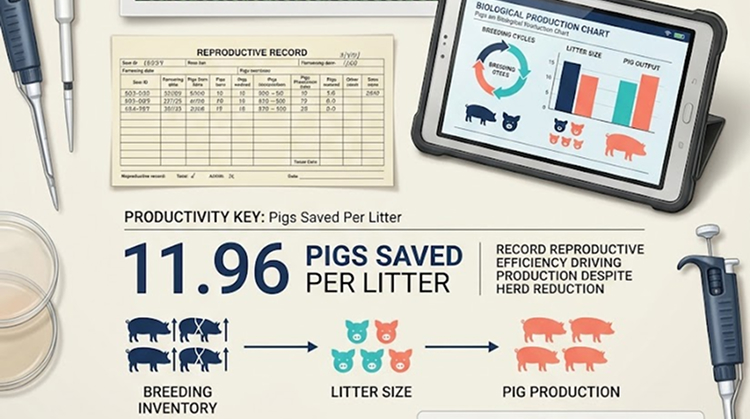
That is a crucial distinction.
The industry is producing fewer pigs overall, but it is producing them at an unusually high rate per litter.
Modern genetics, herd management, nutrition, animal health and production technology have helped pork producers increase output per breeding animal over time. Those improvements allow producers to maintain substantial pork production even when the breeding herd is relatively small.
The relationship can be summarized simply:
| September 2026 Indicator | USDA Figure | Year-Over-Year Change |
|---|---|---|
| All hogs and pigs | 74.3 million | -2% |
| Market hogs | 68.4 million | -2% |
| Breeding inventory | 5.87 million | -1% |
| June-August pig crop | 34.5 million | -2% |
| Pigs saved per litter | 11.96 | Record level |
The figures show why the industry should not interpret the September inventory as a straightforward collapse in production capacity.
The herd is smaller, but productivity remains extremely high.
That makes precision field management and production efficiency increasingly important across agricultural operations, particularly as producers try to control costs while maintaining output.
Iowa Remains The Center Of U.S. Hog Production
The geographic concentration of the U.S. hog industry makes Iowa particularly important to the national market.
USDA reported that Iowa had 24.7 million hogs and pigs on farms as of September 1. Minnesota ranked second with 9.30 million head, while North Carolina ranked third with 7.60 million.
Together, those three states accounted for more than 41 million animals.
Iowa alone represented roughly one-third of the entire U.S. hog inventory.
That concentration means changes in production conditions across the Upper Midwest can have national consequences. Feed availability, transportation costs, processing capacity and animal-health conditions in Iowa and neighboring states can influence the broader pork supply chain.
The regional numbers also demonstrate why national inventory statistics should always be viewed alongside state-level production.
A 2% national decline does not mean every producing state reduced its herd by 2%. Individual operations and regions can be expanding, maintaining or reducing production at different rates.
The USDA state agriculture statistics provide the geographic context needed to understand those differences.
Fall Farrowing Plans Point To Continued Production
The September report also provides an early indication of how producers intend to manage the breeding herd during the next two farrowing periods.
USDA reported that producers intend to have 2.85 million sows farrow between September and November 2026. They intend to have another 2.80 million sows farrow between December 2026 and February 2027.
Those numbers suggest that producers are not making an aggressive expansion push.
Instead, the industry appears positioned to maintain a relatively stable production pipeline while operating with a smaller breeding inventory.
That matters because farrowing intentions are one of the forward-looking components of the Quarterly Hogs and Pigs report.
The number of sows farrowing, combined with pigs per litter and subsequent survival rates, helps determine how many animals eventually become available for slaughter.
The effect is delayed.
A decision made by a producer in September does not immediately change pork supplies at the grocery store. The animals need to move through the production cycle before reaching market weight.
That means the September report is partly a snapshot of current conditions and partly an early guide to pork availability several months from now.
Pork Production Can Stay High Even With Fewer Hogs
A smaller hog inventory does not automatically translate into proportionally lower pork production.
Slaughter weights are another variable.
If animals reach heavier weights before slaughter, processors can produce more pork from a smaller number of animals. USDA’s Economic Research Service has repeatedly incorporated slaughter weights, litter rates and slaughter numbers into its pork production outlook.
The September ERS outlook projected third-quarter commercial pork production at about 6.6 billion pounds, slightly above the same period in 2025. The agency also said sluggish September pork demand had resulted in a small reduction to the production forecast.
That is an important market distinction.
The September inventory report is showing fewer animals, while the production outlook still points to a large quantity of pork entering the market.
The two facts can exist at the same time because production depends on more than the head count.
For pork producers, this means the market is becoming more sensitive to productivity.
A small change in pigs per litter, mortality, average slaughter weight or processing pace can have a meaningful effect on the final supply number.
Demand Will Determine How Much The Smaller Herd Matters
Supply is only half of the pork market.
USDA’s September 18 Hogs & Pork Market Outlook said sluggish pork demand in September contributed to a small reduction in third-quarter production. The agency also reduced quarterly export forecasts for both 2026 and 2027 because of stronger international competition and softer demand in some important foreign markets.
That creates a counterbalance to the smaller hog inventory.
If pork demand remains weak, processors may have less incentive to bid aggressively for hogs even if available supplies decline.
If domestic or export demand strengthens, the same smaller inventory could become much more important.
This is why the September inventory should not be treated as an automatic forecast of higher hog prices.
The market must absorb the available pork.
Retail demand, food-service purchases, exports, processor margins and competing meats will all influence how much value the industry can extract from a smaller livestock supply.
U.S. Pork Exports Add Another Layer Of Risk
The United States is heavily connected to international pork markets.
USDA’s Economic Research Service maintains monthly trade data showing U.S. pork exports by destination and tracks shipments alongside domestic production. The agency’s September outlook said competition and softer foreign demand were weighing on export expectations.
That makes export performance especially important for producers entering a tighter inventory environment.
A smaller domestic hog supply does not automatically mean a tighter global pork market.
Other major pork exporters can increase shipments, while importing countries can shift sourcing based on price, currency movements, disease conditions and trade policy.
The United States therefore has to remain competitive even as domestic livestock numbers decline.
The USDA pork trade data tracks these flows by country and provides a useful measure of how much U.S. pork is moving into international markets.
Producers Are Entering A Market With Less Room For Error
A smaller herd can increase the sensitivity of the industry to production disruptions.
When inventories are large, unexpected losses or temporary production problems can sometimes be absorbed without dramatically changing total supply.

When inventories are smaller, the same disruption can have a greater percentage effect.
Animal health is therefore particularly important.
Disease outbreaks, reproductive problems or elevated mortality can reduce the number of pigs entering the market at a time when the breeding herd is already below the level of a year earlier.
The high litter rate provides some protection, but it cannot eliminate biological risk.
Producers are consequently operating in a market where maintaining reproductive performance is becoming increasingly important.
Feed efficiency, animal health programs, genetics and herd management all have a larger economic role when the number of breeding animals is constrained.
Feed Costs Will Influence Producer Decisions
Hog producers also have to manage the cost side of the equation.
Feed represents one of the largest operating expenses in pork production, making corn and soybean meal prices particularly important to producer margins.
The September 2026 Feed Outlook continues to provide updated projections for U.S. and global feed-grain markets, including the 2026/27 marketing year.
For producers, this creates a complicated relationship between hog prices and feed costs.
Higher hog prices can improve revenue, but the benefit can be reduced if feed costs rise at the same time.
Conversely, lower feed costs can improve margins even when hog prices remain relatively moderate.
This is one reason the smaller inventory should be analyzed alongside grain markets rather than in isolation.
The current U.S. agriculture environment already includes significant movement in corn production forecasts, harvest timing and soybean demand.
For integrated livestock producers, the cost of converting those feed commodities into pork can be as important as the selling price of the hog itself.
The Smaller Breeding Herd Could Matter More In 2027
The September inventory is also relevant beyond the immediate fall market.
The breeding herd is the foundation of future production.
If producers maintain approximately 5.87 million breeding animals and continue achieving nearly 12 pigs per litter, the industry can maintain substantial output.
But if producers begin expanding again, the effects will take time to appear.
Additional breeding animals must enter the production system, farrow, produce piglets and move those pigs through the growing and finishing stages.
That makes hog production inherently slower to adjust than a commodity market where supply can sometimes respond within a single growing season.
The current numbers therefore give the market an important baseline for 2027.
The question is no longer simply whether the U.S. has enough hogs today.
It is whether producers believe market conditions justify expanding the breeding herd tomorrow.
Record Productivity Is Changing The Meaning Of Herd Size
The most interesting feature of the September report may ultimately be the relationship between inventory and productivity.
The United States has fewer hogs than it did a year ago, but producers are getting more pigs from each litter.
The 11.96 pigs saved per litter recorded from June through August was another record, according to USDA.
That means the traditional assumption that a smaller breeding herd automatically produces a proportionally smaller pork supply is becoming less reliable.
Efficiency has changed the production equation.
The industry can produce large quantities of pork with fewer breeding animals than would have been required in earlier decades.
But that efficiency also creates a new dependence.
When productivity reaches exceptionally high levels, future growth becomes harder to achieve through litter-size improvements alone. Producers eventually have to rely more heavily on herd expansion, heavier weights or additional gains in efficiency.
The current market therefore appears to be approaching an important balance point between herd size and biological productivity.
The Next USDA Reports Will Show Whether Supply Is Really Tightening
The September 24 report gives the industry a clear starting point, but it will take several more reports to determine whether the smaller inventory develops into a sustained supply constraint.
Future reports will show whether breeding inventories remain below year-earlier levels, whether farrowing intentions are fulfilled and whether pigs per litter remain near record levels.
Commercial slaughter data will provide another important signal.
If slaughter numbers remain strong despite the smaller herd, productivity and heavier weights may be compensating for reduced inventory.
If slaughter numbers begin falling more quickly, the smaller market-hog supply could become more visible in pork production.
Demand will then determine how strongly the market responds.
USDA’s September outlook already points to softer pork demand and lower export expectations, creating an important counterweight to the smaller livestock inventory.
That means producers are entering a market that is tighter on the supply side without necessarily being short of pork.
The U.S. Hog Market Is Becoming More Dependent On Efficiency
The September 2026 Hogs and Pigs report shows an American pork industry operating with fewer animals but exceptionally high reproductive productivity.
The national inventory of 74.3 million head is down 2% from September 2025, while the market-hog inventory is down by the same percentage. The breeding herd is also smaller, and the June-August pig crop declined 2%.
At the same time, 11.96 pigs saved per litter represents a record level of reproductive efficiency.
That combination means the U.S. pork market is entering a more closely balanced period. Producers have less inventory available than a year ago, but they are extracting more production from every breeding animal.
The next phase will depend on whether that efficiency continues, whether producers increase the breeding herd, how much pork processors require and whether domestic and international buyers absorb the available supply.
For now, the September report does not describe a pork shortage. It describes an industry with less livestock inventory, record productivity and less room for production disruptions.
As the industry moves toward 2027, that balance between herd size and efficiency will become increasingly important for producers deciding whether to maintain their current operations or invest in expansion.