STREAM weed management became a defined federal research priority on August 17, 2026, when the U.S. Department of Health and Human Services, through ARPA-H, launched the Systems for Tracking and Resilience in Efficient Agricultural-input Management program. The stated aim was to support technologies that help farmers control weeds while reducing risks to workers, consumers, and the environment, according to the HHS announcement.
The launch matters because weed control is under pressure from several directions at once. Herbicide-resistant weeds remain a practical challenge for growers, while public agencies and farm communities are paying closer attention to agrochemical movement beyond target areas. The research brief behind the program also points to a wider federal push involving HHS, USDA, and EPA investment in farm modernization and food security. That does not mean the funded tools are ready for broad adoption. It does mean weed management is being treated as both an agronomic and exposure-monitoring issue.
What STREAM Weed Management Funded
STREAM Weed Management Priorities
The STREAM program identified four technical focus areas. First, it called for discovery of novel and biologically derived herbicides targeting resistant weed species, including work using AI and machine learning. Second, it emphasized precision and non-chemical weed-control tools, including laser ablation, autonomous weeders, and real-time drift modeling. Third, it supported improved sensing and monitoring of herbicides through continuous, low-cost sensors. Fourth, it included removal or degradation of herbicides in soil and water before they reach crops or waterways.
Those categories show that the program is not limited to one type of equipment. It spans chemistry, robotics, sensing, and environmental mitigation. For growers, STREAM weed management is most relevant if funded projects eventually reduce unnecessary application, improve weed targeting, or provide better data on where chemicals move after use.
Why The Program Is Broader Than Spraying
Precision spraying receives much of the attention in farm technology discussions because it connects directly to input costs and field operations. Yet the STREAM structure also recognizes that weed control decisions do not end at the nozzle. Detection, decision-making, application, drift risk, runoff risk, and degradation all affect whether a system is useful in real fields.
This broader framing is consistent with recent site-specific weed management research summarized in the research notes. A systematic study published on August 4, 2026 found that only about 40 of 563 studies covered the full workflow of detection, decision-making, and herbicide application under realistic farming conditions. That finding is a caution sign. Many tools can perform well in one step of the process, but farms need systems that work across the full chain.
What WATCH Adds To STREAM Weed Management
Field Monitoring As A Core Technology
The first named award under the program came on September 9, 2026, when ARPA-H awarded up to $10.9 million to Fieldstone Bio of Woburn, Massachusetts, for Wide-area Agrochemical Tracking for Contaminant and Health mapping, known as WATCH. The project aims to use engineered soil microbes to sense and report agrochemical presence in real time through remotely detectable color signals, according to the ARPA-H award notice.
The concept is notable because it focuses on visibility. If a system can report agrochemical presence in field margins, runoff areas, waterways, or other exposure-prone locations, it could give farmers and regulators more timely information than periodic sampling alone. The available description does not prove that the approach will work at commercial scale. It does, however, show where the research priority is moving: toward monitoring that is continuous, field-based, and connected to real exposure pathways.
Practical Questions For Farms
Several farm-level questions remain unanswered. Growers would need to know how such sensors perform across soil types, rainfall patterns, crops, and chemical programs. They would also need clear guidance on what the signal means for management decisions. A sensor that detects agrochemical presence is only useful if the data can be interpreted quickly and tied to action, such as changing buffer practices, adjusting application timing, or identifying runoff risk.
STREAM weed management also raises data ownership and communication questions. If monitoring systems report conditions near waterways or field edges, producers will want to understand who receives the data, how it is validated, and how uncertainty is handled. Those details were not resolved in the launch materials, so adoption should be discussed with care rather than assumed.
Precision Weed Control Still Faces Field Barriers
Detection Has Improved, But Deployment Is Uneven
Recent research summarized in the notes shows progress in computer vision for weed detection. A March 2026 review reported a shift toward pixel-level segmentation rather than simple bounding boxes in site-specific weed management. It also found emerging use of Transformer models compared with traditional convolutional neural networks. Still, few systems have been deployed on edge devices because hardware limits and field reliability remain constraints.
That distinction matters for growers. A model that works on stored images is not the same as a system that performs under dust, changing sunlight, crop residue, wind, variable weed size, and equipment vibration. Precision weed control has to be fast enough to make decisions while the machine moves through the field. It also has to be accurate enough that missed weeds and crop injury do not erase the expected benefits.
Field Performance Can Lag Lab Results
The research notes include a useful example from vegetable production. A machine vision-guided sprayer prototype reported in December 2025 used 12 independently controlled nozzles over a 0.66-meter width. In lab conditions, it achieved an mAP@50 of 86.6% and a hit rate of 88.4%. In field conditions against lambsquarters and purslane, performance dropped to about 48.9% mAP@50 and 51.3% hit rate.
That gap should not be read as failure. It is a reminder that commercial field use is a higher standard than controlled testing. The same issue applies to autonomous weeders, lasers, and real-time drift models. Each tool has to be judged on field reliability, maintenance needs, crop fit, speed, and economic return.
Commercial Mapping Signals A Near-Term Path
Weed Maps May Reach Farms Before Full Automation
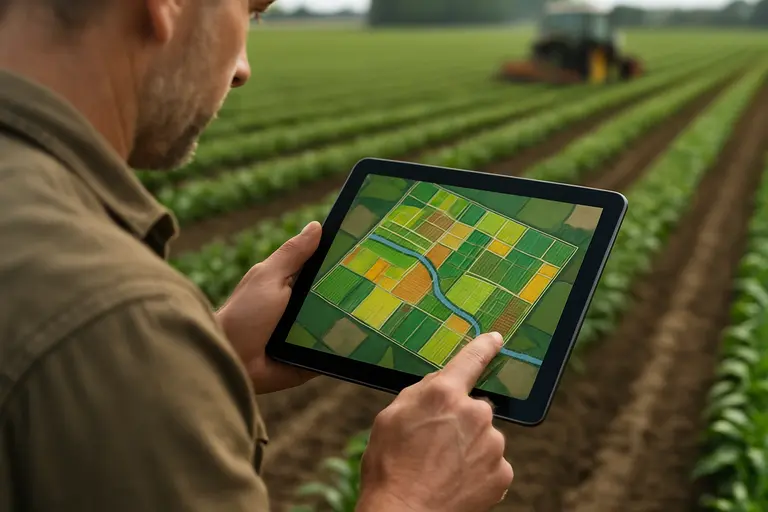
Some services appear closer to practical use because they fit into existing sprayer workflows. The research notes report that TerraClear launched commercial weed mapping services for corn and soybeans on August 25, 2026. The service offered quarter-inch weed detection, full-field imagery at 1.5-millimeter resolution, and maps that integrate with section- or nozzle-controlled sprayers. The same notes state that its platform had already produced rock and weed maps over more than 1.5 million acres for more than 1,000 farming operations.
Mapping does not automatically reduce herbicide use. It depends on whether the map is timely, accurate, and compatible with the sprayer. It also depends on whether the operator can act on the map without slowing fieldwork. Still, mapping services may be one of the more practical entry points for farms that are not ready to invest in full machine-vision spraying systems.
For readers tracking how sensing, AI, and farm equipment are being tested across crops, Agheiro’s coverage of AI precision agriculture tools provides related context on field workflows. Community understanding also matters because herbicide decisions affect workers, neighbors, and local water concerns; related network resources such as Bethel NC UMC, which can be found at this site, reflect how local institutions often become part of broader conversations about stewardship and public trust.
STREAM Weed Management And Farm Risk
What Producers Can Watch Next
The most practical reading of the STREAM launch is that weed control research is moving toward integrated systems. Farmers should watch whether funded projects can connect detection, treatment, monitoring, and mitigation in ways that fit real equipment and seasonal timing. A technology that requires too much labor, too much calibration, or too much data processing may struggle even if the science is promising.
Producers can also evaluate these developments through a risk lens. Key questions include whether a tool reduces whole-farm herbicide exposure, whether it preserves weed control, whether it works across weed species and growth stages, and whether it adds clear value after accounting for service fees, equipment changes, training, and downtime. Those questions are especially relevant for farms dealing with resistant weeds, sensitive field borders, or high-value crops where off-target damage can be costly.
A Cautious Read On The 2026 Launch
The STREAM program’s 2026 launch and the WATCH award mark a significant federal signal, but they do not settle the economics of adoption. The strongest near-term value may come from better measurement: more precise weed maps, improved drift awareness, and clearer evidence of where agrochemicals move after application. Over time, biological sensing, autonomous weeders, laser systems, and new herbicide discovery could widen the set of options available to growers.
For now, the evidence supports a cautious view. STREAM weed management has created a structured funding pathway for technologies that could reduce waste and improve accountability in weed control. The next test is whether those projects can move from promising concepts to tools that operate reliably in commercial fields, across weather, soils, crops, and the demanding pace of farm operations.