The outlook for U.S. agriculture is entering a more uncertain phase as El Niño strengthens across the Pacific and raises the probability of unusually large weather disruptions during the 2026–27 crop and marketing cycle. NOAA’s Climate Prediction Center said in July that El Niño had strengthened, with an 81% probability of a very strong event during October–December 2026, potentially placing the event among the strongest recorded since 1950.
That forecast matters for American agriculture because El Niño does not produce one uniform weather outcome. Its influence varies by region, season and crop. Some U.S. agricultural areas can receive greater precipitation while others experience warmer or drier conditions. The result is a complicated risk picture for corn, soybeans, wheat, livestock, specialty crops and the transportation infrastructure that connects farms with domestic and export markets.
The timing is particularly important. USDA’s latest market outlooks entered the 2026–27 marketing year with substantial production expectations. U.S. soybean production was forecast at a record 4.5 billion bushels, while feed-grain production was projected at 420.1 million metric tons, the second-largest level on record. A major shift in weather conditions could therefore affect markets that are currently pricing in relatively abundant supplies.
El Niño Moves From Forecast To Agricultural Risk
El Niño is characterized by warmer-than-average sea-surface temperatures across the central and eastern equatorial Pacific, accompanied by changes in atmospheric circulation. By July 2026, NOAA reported a Niño-3.4 temperature anomaly of +1.2°C, with the eastern Pacific showing even stronger warmth.
By the end of July, the Niño-3.4 anomaly had reached +1.4°C, consistent with the upper end of a moderate El Niño at that point in the season. NOAA continued to maintain an El Niño Advisory.
The latest forecasts suggest that the pattern could intensify considerably.
Reuters reported on August 13, 2026, that the U.S. Climate Prediction Center saw a greater than 90% probability of a very strong El Niño during the Northern Hemisphere fall and winter, while the probability that October–December conditions could reach historic strength was estimated at 69%.
Those numbers do not mean that a specific U.S. farm will experience drought, flooding or a crop failure. El Niño is a probability-shifting climate pattern rather than a precise local forecast.

For producers and commodity traders, however, a stronger signal changes the range of scenarios that must be considered.
NOAA Climate Prediction Center El Niño Outlook
Corn And Soybeans Enter The New Risk Environment With Large Acreage
The potential impact on U.S. markets begins with the size of the crops already being anticipated.
USDA’s June 30 Acreage report estimated that farmers planted 95.3 million acres of corn in 2026 and 85.4 million acres of soybeans. Soybean acreage increased 5% from 2025, while corn acreage declined.
The USDA Economic Research Service subsequently projected record soybean production of 4.5 billion bushels for the 2026/27 marketing year. The agency also maintained a U.S. soybean ending-stock forecast of 310 million bushels and a season-average soybean price forecast of $11.40 per bushel in its July outlook.
Those numbers establish an important baseline.
A market entering the season with expectations for large production has less room for weather-related disappointment before supply estimates begin to change. Conversely, if favorable weather offsets El Niño-related risks, large production could keep pressure on prices.
Corn faces a similar dynamic. USDA’s July outlook put total U.S. feed-grain production at 420.1 million metric tons, up slightly from the previous month and about 4% above the next-largest production year, 2023.
That means weather is operating against a backdrop of substantial expected supply rather than an already constrained market.
The Midwest May Not Experience El Niño In A Uniform Way
The most important mistake in interpreting an El Niño forecast is treating it as a nationwide weather forecast.
The Midwest can experience very different conditions depending on the strength and location of atmospheric circulation changes. Corn and soybean producers in Iowa, Illinois, Indiana, Minnesota, Nebraska and surrounding states will ultimately be affected by local rainfall, soil moisture, temperature and timing.
For crops, timing can be more important than a seasonal average.
A moderate rainfall deficit during a period of low crop water demand may have limited consequences. A similar deficit during reproductive development can have much greater implications. Likewise, excessive precipitation can be beneficial for soil moisture early in a season but create planting, disease, nutrient-loss or harvest problems later.
This is why El Niño should be viewed as a risk multiplier rather than a direct yield forecast.
Agheiro’s Precision Farming coverage is particularly relevant to this changing environment because field-level technology can help farmers distinguish regional climate signals from conditions actually occurring within individual fields.
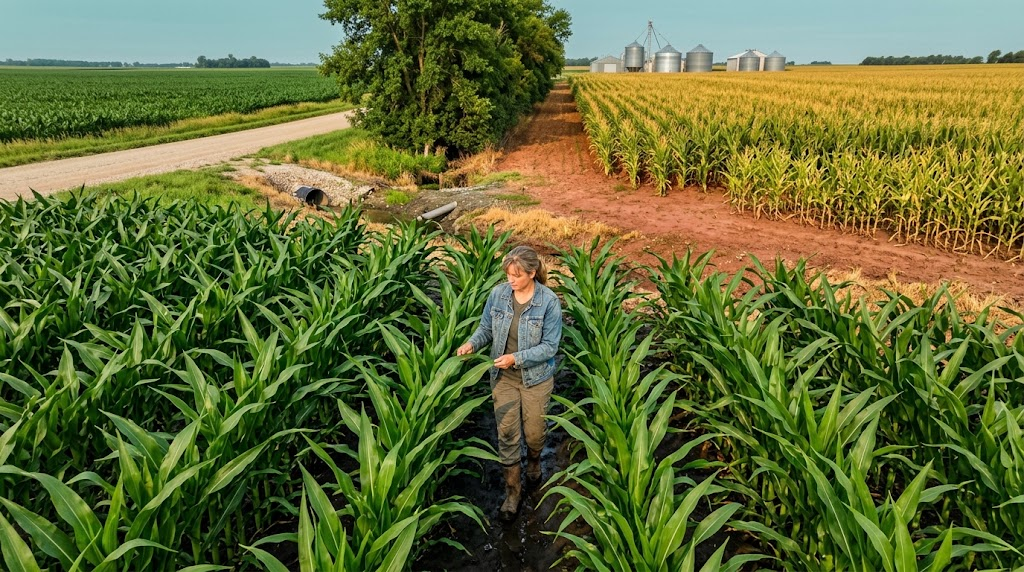
Satellite imagery, soil-moisture sensors and localized weather stations can reveal differences that national or state averages cannot capture.
Wheat Markets Could Face A Different Set Of Weather Signals
The potential consequences extend beyond corn and soybeans.
Winter wheat and spring wheat production operate on different seasonal calendars and have different relationships with temperature and precipitation. An El Niño pattern that becomes more influential during the colder months could therefore alter planting, winter survival, soil moisture and spring development conditions.
The effect is particularly important for the Plains.
Kansas, Oklahoma, Colorado and Nebraska form a major portion of the U.S. winter-wheat production system. Weather conditions across those states influence both domestic flour supplies and export availability.
A strong El Niño does not automatically mean drought in the Plains. Instead, it changes the probabilities around precipitation and temperature patterns. Farmers and traders must therefore watch actual observations rather than treating the climate pattern itself as a production estimate.
This distinction is becoming increasingly important as commodity markets react faster to weather information.
Southern And Western Agriculture Face Their Own Exposure
El Niño’s agricultural implications are not limited to the Corn Belt.
USDA’s Northwest Climate Hub notes that El Niño can influence Alaska, Idaho, Oregon and Washington, particularly during winter. The agency’s climate specialists say NOAA was projecting a 63% chance of a very strong El Niño during November 2026 through January 2027 in the information available to the hub.
The Pacific Coast has another layer of exposure because ocean temperatures, precipitation patterns and winter storms affect water resources, snowpack and agricultural planning.
NOAA’s California Current assessment also identified expected effects from the 2026–27 El Niño along the West Coast, with warmer-than-normal ocean conditions potentially affecting marine and coastal systems beginning in late summer and continuing through winter.
For agriculture, the most important connection is water.
Western producers depend on a combination of reservoirs, groundwater, snowpack, rivers and managed irrigation systems. Changes in winter precipitation do not necessarily translate immediately into additional water for farms. The timing, location and form of precipitation all matter.
A wet storm pattern can replenish reservoirs but also create flooding. Snow in mountain watersheds can provide a delayed water supply that becomes important months later.
South American Weather Could Change U.S. Market Competition
The El Niño story becomes even more important when global production is considered.
The United States does not compete with weather in isolation. American corn and soybean prices are influenced by production in Brazil and Argentina, export logistics, currency movements, livestock demand and international purchasing.
Reuters reported that the emerging El Niño could produce wetter conditions in southern portions of South America while increasing drought and heat risks in northern and western Brazil.
That creates an unusual possibility for U.S. farmers.
An El Niño event can simultaneously threaten production in one major exporting region while improving conditions in another. The final market impact depends on which areas produce more or less than expected and how quickly global buyers respond.
For U.S. soybeans, Brazil is particularly important because of its position in global soybean exports. A weather-driven reduction in Brazilian supplies could increase demand for U.S. soybeans even if domestic American production remains large.
The opposite can also occur.
If South American weather produces strong crops while U.S. farmers face weather problems, global buyers may have alternatives that limit how strongly U.S. prices respond.
Commodity Markets Could Become More Sensitive To Weather Data
The prospect of a strong El Niño is already increasing attention from commodity markets.
Reuters reported on August 18 that concern over the developing pattern was affecting agricultural commodity markets globally, with risks ranging from excessive rainfall to drought depending on the region.
For U.S. grain markets, the key issue is not simply whether El Niño becomes historically strong.
Markets will focus on whether the weather pattern changes production expectations.
That distinction matters because agricultural prices respond to supply-and-demand balances rather than climate headlines alone.
If corn yields remain strong, the large expected production base could keep supplies comfortable. If soybean production reaches the USDA’s projected record, additional supply could limit price increases. But if weather reduces yields enough to change ending-stock calculations, markets could respond quickly.
The same process applies to wheat.
A small change in expected production can produce a much larger change in futures-market expectations when inventories are already tight. Conversely, abundant stocks can absorb a production setback without creating a major shortage.
Livestock Producers Could See Indirect Effects
El Niño can also influence agricultural markets through livestock.
Corn and other feed grains represent major inputs for cattle, hog and poultry producers. Changes in corn prices therefore affect feeding costs even when livestock production itself is not directly damaged by weather.
If weather reduces grain production, higher feed costs could pressure livestock margins.
If favorable conditions produce another large corn crop, feed costs could remain relatively manageable.
Pasture conditions provide another link. Cattle producers in regions affected by unusual precipitation may face changes in forage availability, hay production and supplemental-feed requirements.
The market consequences can therefore move in both directions.
A weather event that hurts crops does not necessarily hurt every agricultural producer. Higher grain prices can benefit crop producers with strong yields while increasing expenses for livestock operators.
Farmers Have More Data But Not More Control Over Weather
The growing importance of El Niño also highlights the role of agricultural data.
Farmers now have access to satellite imagery, field-level weather observations, soil sensors, yield maps, irrigation monitoring and increasingly sophisticated forecasting tools. These technologies can improve decisions about irrigation, fertilizer application, planting timing and harvest preparation.
They cannot eliminate the underlying biological constraints created by extreme weather.
A farmer can detect declining soil moisture earlier, but that does not guarantee access to additional water. A producer can identify crop stress from satellite imagery, but stressed plants cannot always recover. A weather model can identify elevated risk weeks ahead, but the final rainfall distribution can still differ from the forecast.
The practical value of precision agriculture is therefore increasingly about reducing uncertainty rather than eliminating risk.
That distinction will become more important if the 2026–27 El Niño reaches the strength currently projected.
U.S. Agriculture Enters A More Uncertain 2026–27 Market
The emerging El Niño does not provide a simple bullish or bearish signal for U.S. agricultural commodities.
Instead, it expands the range of possible outcomes.
NOAA’s July assessment gave El Niño a 97% chance of persisting through early spring 2027, while estimating an 81% probability of a very strong event during October–December 2026. More recent reporting from Reuters indicates that the U.S. Climate Prediction Center has placed the probability of a very strong event above 90% for the Northern Hemisphere fall and winter.
That progression is significant.
At the beginning of the 2026 growing season, farmers were primarily managing the immediate weather affecting planting and crop establishment. As summer progresses, attention is shifting toward how the Pacific pattern could influence the months ahead.
For U.S. agriculture, the most important variables will be actual rainfall, temperature, soil moisture, crop condition, winter precipitation and global production—not the El Niño label itself.
The market starts with substantial expected supplies: 95.3 million corn acres, 85.4 million soybean acres and a USDA soybean production forecast of 4.5 billion bushels. Those figures provide a strong production baseline, but weather remains capable of moving the balance substantially.
The coming months will therefore be less about predicting exactly what El Niño will do and more about measuring how its evolving atmospheric pattern translates into conditions across individual agricultural regions.
For producers, grain elevators, livestock operators and commodity traders, that means the next critical indicators will come from the combination of NOAA seasonal forecasts, USDA crop-condition reports, soil-moisture observations and South American planting-weather data.
The strength of the 2026–27 El Niño may become historic, but its ultimate importance to U.S. agriculture will be determined in the fields, where temperature, rainfall and water availability meet the crop already planted.