The U.S. corn and soybean markets are approaching one of the most closely watched agricultural data releases of the summer. The USDA National Agricultural Statistics Service is scheduled to publish its August Crop Production report on August 12, 2026, giving producers, grain traders, analysts, and agricultural businesses a new assessment of 2026 production potential. The report will arrive after several weeks of heat, uneven rainfall, and shifting crop conditions across major growing regions.
The timing is significant. The June USDA Acreage report estimated 95.3 million acres of corn planted in 2026, down 3% from the previous year, while soybean acreage was projected at 85.4 million acres, up 5%.
Those acreage numbers established the starting point for the 2026 supply outlook. The August production report will add another layer by updating yield expectations as corn moves deeper into grain development and soybeans progress through pod formation.
The latest weekly crop report already provides evidence that national crop conditions are changing. Through August 9, 61% of corn was rated good to excellent, unchanged from the previous week, while soybean conditions slipped to 62% good to excellent, one percentage point lower.
The new production estimates could influence how markets interpret those conditions.
USDA Crop Report Arrives At A Critical Point
The August Crop Production report is different from an early-season planting update because the USDA has considerably more information available by this stage of the growing season.
Crop progress has advanced far enough for field observations to provide a clearer picture of reproductive development. Corn has moved through silking and into the dent stage in a growing portion of the country, while soybeans are progressing through blooming and pod-setting stages.
The USDA Crop Production schedule lists the August 2026 Crop Production release for Wednesday, August 12. The report is scheduled alongside several other USDA statistical releases, making the date particularly significant for agricultural markets.
The August estimate will not represent the final harvest result. Weather conditions can still change yield prospects during the remainder of August and into September. Yet the report gives the market a more developed production benchmark than the estimates available earlier in the summer.
That distinction matters for corn. Yield potential can be strongly affected by conditions surrounding pollination and early grain development. Soybeans retain substantial yield potential later into the season, meaning August weather can continue influencing pod numbers and seed development.
The USDA report will therefore be read alongside weather forecasts, crop-condition ratings, export demand, and futures-market positioning.
Corn Acreage Leaves Less Room For Yield Disappointment
The 2026 corn market begins August with a smaller planted area than last year.
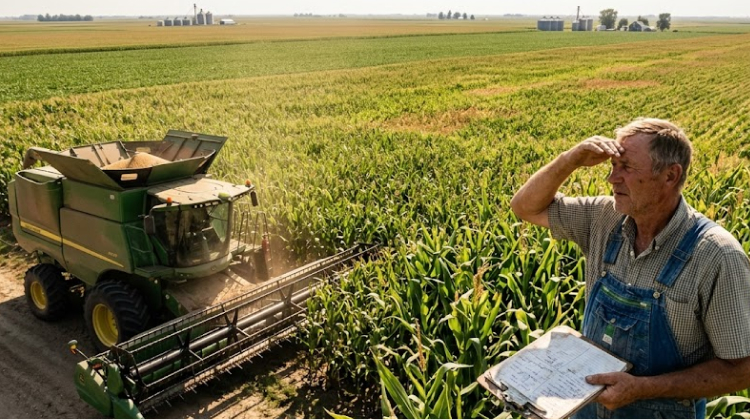
USDA estimated corn planted acreage at 95.3 million acres, compared with 98.7 million acres in 2025. The 3% reduction represents roughly 3.4 million fewer planted acres.
| Crop | 2025 Planted Acres | 2026 Planted Acres | Change |
|---|---|---|---|
| Corn | 98.7 million | 95.3 million | -3% |
| Soybeans | 81.2 million | 85.4 million | +5% |
A lower planted area does not automatically mean lower production. Higher yields can offset fewer acres. That is why the August yield estimate will be closely watched.
The latest crop-progress data provide some reason for caution without establishing a national production decline. Corn condition remained at 61% good to excellent for the week ending August 9.
The USDA crop progress data provide weekly measurements of crop development and condition across major producing states. These reports allow analysts to compare current development with previous years and five-year averages.
The key market question is whether the August yield estimate reflects the generally strong crop condition ratings or incorporates enough regional weather stress to reduce expected production.
Heat And Moisture Add Uncertainty To Yield Estimates
Weather has become the most important variable surrounding the August report.
NOAA’s Climate Prediction Center has maintained above-normal temperature probabilities across substantial portions of the United States. Its long-lead outlook for August through October favors above-normal temperatures across much of the contiguous United States.
The combination of temperature and soil moisture is more important for crops than temperature alone.
When soil moisture remains adequate, crops can continue transpiring and moderating leaf temperatures. When soil moisture becomes limited, high temperatures place greater stress on plants and can reduce photosynthetic activity.
The NOAA agricultural climate information provides temperature, precipitation, soil-moisture, and historical climate data used by agricultural researchers and producers to evaluate weather conditions.
Regional variation makes the national picture difficult to interpret from one number.
Iowa, Illinois, Indiana, Minnesota, Nebraska, Ohio, and South Dakota all contribute significantly to U.S. corn and soybean production, yet their soil profiles and rainfall patterns differ. A national crop rating can remain relatively stable even when individual production areas experience significant stress.
That regional variation will be one of the major issues analysts examine after the August report.
Corn Development Has Moved Into A Yield-Sensitive Period
The latest crop-progress numbers show how far the 2026 corn crop has advanced.
Through August 9, corn silking was reported at 93% nationally, according to reporting on the latest USDA Crop Progress release. Corn dented reached 16%, showing that a measurable portion of the crop has moved into grain development.
That timing gives weather conditions a direct connection to yield potential.
The dent stage marks an important transition as kernels accumulate dry matter. Fields with sufficient moisture can continue developing grain effectively, but severe stress during this period can reduce final kernel weight.
This does not mean every hot or dry period will produce a measurable yield loss. Crop response depends on soil-water reserves, hybrid characteristics, rooting depth, rainfall distribution, and the duration of stress.
The August report will therefore be evaluated against field conditions rather than treated as a final verdict on the harvest.
Soybean Acreage Creates A Different Supply Equation
Soybeans entered 2026 with a very different acreage story.
USDA’s June estimate placed soybean planted acreage at 85.4 million acres, 5% above the 81.2 million acres reported for 2025. The increase adds roughly 4.2 million acres to the national soybean production base.
That additional acreage provides producers and markets with more potential supply, but acreage alone cannot determine the final harvest.
Soybean yield depends heavily on conditions during flowering and pod development. The crop can continue producing new reproductive structures through August, making late-summer rainfall particularly significant.
The latest USDA condition report showed 62% of soybeans rated good to excellent, down from 63% the previous week. Another 28% was rated fair, while 10% was rated poor or very poor.
The one-point decline is relatively small, but the direction matters when combined with weather conditions.
The USDA soybean production data will become more important as the agency incorporates additional information into its production estimates.
For soybean producers, the August report could establish whether the larger planted area is translating into a substantially larger expected harvest or whether weather conditions are limiting yield potential.
Soybeans Still Have More Development Ahead
Soybeans have a longer reproductive window than corn, which changes the way farmers interpret August weather.

The latest report showed soybean blooming at 93%, while pod-setting continued across the country.
That means rainfall during the coming weeks can still influence yield potential.
A soybean field that looks strong during early August can produce a very different result if moisture becomes severely limited during pod fill. Conversely, timely rainfall can allow plants with moderate stress to recover and continue developing.
This makes the soybean market particularly sensitive to August weather forecasts.
The larger soybean acreage estimate creates additional supply potential, but actual production depends on the interaction between acres and yield. A larger harvested area paired with a lower yield can produce a much smaller supply increase than acreage data initially suggest.
Grain Markets Will Compare USDA Data With Weather Signals
The August Crop Production report will be released into an active information cycle.
USDA’s Foreign Agricultural Service is scheduled to release its August 12 Grains: World Markets and Trade report, covering U.S. and global production, consumption, stocks, and trade for corn and other coarse grains.
That means the market will receive domestic production information and international grain-market data within the same reporting window.
Corn prices will respond to the relationship between expected production and demand. Soybean prices will face a similar calculation, with domestic acreage, yields, export demand, crushing activity, and global competition all contributing to the outlook.
The market reaction could be substantial if the USDA numbers differ significantly from trade expectations.
A yield estimate above expectations could reinforce a bearish supply outlook, particularly if demand projections remain unchanged. A lower-than-expected yield estimate could have the opposite effect by reducing projected supply.
The response will depend on the size of the change and how much of that information has already been reflected in futures prices.
Crop Conditions Will Remain Important After August 12
The August report will establish a new benchmark, but it will not eliminate production uncertainty.
The USDA continues publishing weekly Crop Progress reports through the growing season. The 2026 schedule lists additional reports for August 17, August 24, and August 31 before the September reporting cycle begins.
Those weekly updates will allow producers and analysts to monitor whether the August production estimate remains consistent with field conditions.
This is particularly relevant if temperatures remain elevated or precipitation becomes uneven during the remainder of the month.
A production forecast can change as more field information becomes available. Weather events, disease pressure, lodging, and late-season moisture can all affect the eventual harvest.
The USDA NASS crop reporting system provides the recurring data needed to track those changes from one reporting period to the next.
Precision Agriculture Can Add Field-Level Context
The national production report provides an important market benchmark, but farmers increasingly have access to information at much smaller geographic scales.
Satellite imagery, soil-moisture sensors, weather stations, crop scouting applications, and drone imagery can help producers identify variations inside individual fields.
That information becomes especially valuable during periods of uneven rainfall.
A farm in central Iowa can have different soil moisture conditions from another operation only a few miles away. A field with deeper soils may maintain yield potential through a short dry period, while lighter soils can experience stress much sooner.
Agheiro’s previous analysis of precision crop monitoring examined how agricultural technology is giving growers more detailed information about crop conditions.
The August USDA report works at the national and state level. Precision farming tools work at the field level. Together, these information sources provide a more complete picture of production risk.
August Data Could Redefine The 2026 Grain Outlook
The August Crop Production report arrives at a point when the 2026 corn and soybean crops have accumulated enough development data for yield expectations to become more meaningful.
Corn acreage is lower than in 2025, soybean acreage is higher, and both crops have reached important reproductive stages. Current condition ratings remain relatively strong, but soybean ratings have slipped and regional heat and moisture conditions continue to create uncertainty.
The USDA report scheduled for August 12 will give markets a new production benchmark.
The most important numbers will be the estimated yields and production totals for corn and soybeans, but their significance will depend on how they compare with acreage, crop conditions, weather forecasts, demand expectations, and previous market estimates.
For farmers, the report can influence marketing decisions and storage planning. For grain buyers and processors, it provides another assessment of potential supply. For traders, it can change expectations about inventories and prices.
The 2026 harvest is still weeks away, so the August numbers should be treated as an important checkpoint rather than the final production result. Weather will continue to determine how much of the crop’s current potential reaches the bin.
As the USDA moves from acreage estimates toward increasingly detailed production forecasts, the difference between what was planted and what the weather allows farmers to harvest will become the central issue for the U.S. corn and soybean markets.