Agricultural innovation increasingly depends on the quality of research environments supporting farmers, scientists, and technology developers. From precision planting systems to climate-resilient crop varieties, many of the tools entering modern farms begin inside university laboratories, experimental fields, and agricultural research facilities.
The U.S. Department of Agriculture is increasing support for this research foundation through major investments aimed at improving agricultural infrastructure across the country. Through the National Institute of Food and Agriculture (NIFA), USDA continues expanding funding opportunities that help universities and research institutions modernize facilities used for agricultural science.
The investment comes at a time when American farmers are adopting more data-driven production methods. Crop monitoring systems, automated equipment, soil analysis platforms, and biotechnology research require advanced facilities capable of testing these technologies before large-scale adoption.
Research infrastructure has become a key factor in determining how quickly agricultural discoveries move from laboratories into commercial farming operations.
USDA Expands Agricultural Research Infrastructure Funding
The USDA National Institute of Food and Agriculture supports agricultural research facilities through programs focused on improving infrastructure, equipment, and scientific capabilities.
The Research Facilities Act Program provides funding for eligible institutions working on agricultural research, education, and extension activities. Recent investments have focused on strengthening facilities that support areas such as crop science, animal agriculture, environmental studies, and agricultural technology.
The USDA agricultural research programs provide resources that allow universities and research organizations to modernize aging infrastructure and improve scientific capacity.
| Research Area | Facility Applications | Agricultural Impact |
|---|---|---|
| Crop Science | Greenhouses, field research stations, laboratories | Improved crop varieties and production methods |
| Precision Agriculture | Data centers, sensor testing areas, technology labs | Better farm monitoring and decision-making |
| Soil Research | Testing facilities and environmental analysis centers | Improved nutrient management |
| Climate Research | Controlled environments and field trials | More resilient agricultural systems |
Modern agricultural research requires more than traditional laboratory space. Scientists need facilities capable of handling large datasets, testing equipment, analyzing environmental conditions, and studying crop responses under controlled conditions.
These investments help create the foundation for future farming systems.
Universities Become Testing Centers For Agricultural Technology
Agricultural universities across the United States serve as important connections between scientific research and farm operations.
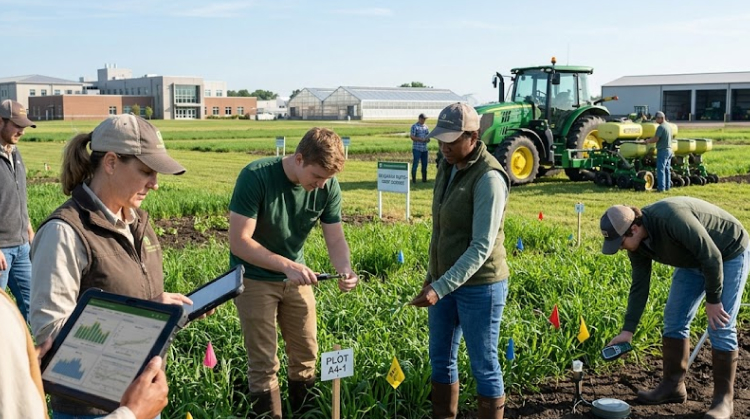
Institutions such as land-grant universities operate experimental farms, research laboratories, and extension programs that allow scientists to evaluate new agricultural approaches in real-world conditions.
Research facilities support projects involving:
- Autonomous farming equipment testing
- Crop genetics studies
- Soil health monitoring
- Water efficiency research
- Agricultural robotics development
The National Institute of Food and Agriculture works with universities and research organizations to support projects that address production challenges affecting American agriculture.
The relationship between universities and farmers allows researchers to test technology under conditions similar to commercial operations. A soil sensor system, for example, must demonstrate value across different soil types, weather patterns, and crop production systems before farmers consider widespread adoption.
Research infrastructure provides the controlled environment needed to evaluate these technologies.
Agricultural Research Addresses Climate And Resource Challenges
American agriculture faces increasing pressure from drought conditions, extreme temperatures, changing precipitation patterns, and resource limitations.
Research facilities allow scientists to study how crops respond to environmental stress and develop strategies that improve farm resilience.
Controlled environments such as greenhouses and climate research facilities allow researchers to adjust temperature, water availability, and soil conditions to evaluate crop performance.
| Research Focus | Technology Used | Farming Benefit |
|---|---|---|
| Drought Resistance | Controlled climate facilities | Improved crop survival during dry periods |
| Soil Health | Laboratory analysis systems | Better nutrient management |
| Water Efficiency | Irrigation testing facilities | Reduced water consumption |
| Crop Protection | Research fields and laboratories | Improved pest management |
These studies provide farmers with information needed to adapt production methods.
For example, researchers can identify crop varieties that perform better under limited water conditions or evaluate irrigation strategies that maintain yields with fewer resources.
Federal Investment Supports Long-Term Agricultural Competitiveness
Agricultural research investments influence more than individual farms. They contribute to the broader competitiveness of the U.S. agricultural sector.
Countries around the world are increasing investment in agricultural technology, automation, and food production research. Maintaining strong research infrastructure helps American agriculture continue developing new solutions for production challenges.
The USDA Economic Research Service studies agricultural productivity trends and provides data on how innovation affects farming efficiency and economic performance.
Research facilities create opportunities for collaboration between universities, government agencies, technology companies, and producers.
A new agricultural technology often requires expertise from multiple fields. Engineers develop equipment, computer scientists create software systems, plant scientists study crop responses, and farmers provide practical feedback from field conditions.
Research facilities bring these groups together.
Private Agricultural Companies Benefit From University Research Partnerships
Agricultural technology companies frequently collaborate with universities and research institutions to test new products.
These partnerships help companies evaluate whether innovations perform effectively before commercial release.
Examples include:
- Drone technology companies testing crop imaging systems
- Equipment manufacturers evaluating automation features
- Biotechnology firms studying improved crop traits
- Software developers testing agricultural data platforms
University research provides independent testing environments that help identify strengths and limitations of new technologies.
Farmers benefit from this process because commercial products reaching the market have undergone additional evaluation.
Precision Agriculture Development Depends On Advanced Research Facilities
Precision farming has become one of the fastest-growing areas of agricultural innovation. Farmers increasingly rely on satellite imagery, artificial intelligence, automated equipment, and field sensors to improve production decisions.
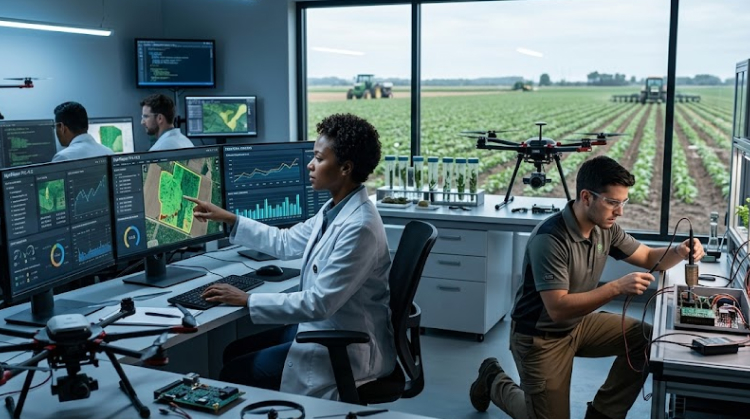
Before these technologies reach farms, researchers must test their accuracy and reliability.
Agricultural research facilities allow scientists to evaluate:
- Sensor performance in different soil conditions
- Machine learning models for crop prediction
- Drone-based crop monitoring systems
- Variable-rate application technologies
- Automated equipment operations
Agheiro’s previous coverage of AI crop monitoring systems examined how technology is changing field management practices across California farms.
Research centers provide the testing environment needed to improve these systems before farmers invest in new tools.
A precision agriculture platform must provide reliable recommendations before it can influence decisions involving expensive inputs such as fertilizer, irrigation water, and seed.
The Future Of Agricultural Innovation Depends On Research Capacity
The next generation of agricultural technologies will require advanced research environments capable of handling increasingly complex challenges.
Artificial intelligence, robotics, biotechnology, and environmental monitoring systems are creating new opportunities for improving agricultural production.
Research facilities will play a major role in determining how quickly these innovations become practical tools for farmers.
The USDA investment approach reflects a broader shift toward strengthening the scientific foundation behind American agriculture. Improved facilities support researchers studying crop production, resource management, and technology applications that will influence farming decisions for years.
As agriculture continues adopting more data-driven systems, research infrastructure will remain one of the most important components connecting scientific discoveries with practical solutions on farms across the United States.